
Transform Your Grades, Transform Your Future

Expert Online Tutoring That Matches Your Curriculum, State Board, and One-on-One Support for K-12 Students

Explore articles on exam prep, time-management hacks, study resources, and global curriculum updates. .
Whether it’s O/A Levels, State Boards, or International exams, our blog keeps you ready and informed.

Parent and child enjoying fun learning activities at home together, reconnecting through conversation and play to make your child love learning again. Primary keyword used: make your child love learning again Secondary keyword included: learning fun activities
Uncategorized
WebGrade Tutors

Reconnect Your Child with Learning: Conversation Tips + Fun Activities

How to Make Your Child Love Learning Again with Fun Activities: Simple Conversations That Work When you ask, “How was school today without any fun activities?” and your child answers “Fine,” it can feel like a conversation dead end. Many parents see the spark fade: once-eager kids retreat to screens, say reading is boring, or worry about tests. The good news is you can make your child love learning again — and the key is how you talk with them and what small fun activities you choose together. This guide gives simple, practical conversation tips for kids, everyday child love learning fun activities, and ways to reduce school stress so your child gets excited about school and learning again. This article gives you conversation strategies, effortless daily fun activities, and mindset shifts so your child gets excited about school and learning again. Whether they’re little or a tweener, these ideas work with everyday life and small moments. Why “How Was School?” Doesn’t Help You Make Your Child Love Learning Again Asking “How was school?” asks a child to summarise their whole world in one word. That’s hard. When questions are too broad, kids often: Give one-word answers. Assume they’re being tested or in trouble. Forget the interesting parts of their day. Research and educator advice recommend swapping general prompts for specific ones to draw out stories and thinking — a practical way to rebuild curiosity and connection. Edutopia Questions That Help Make Your Child Love Learning Again Changing your questions changes the conversation. Use these patterns to open curiosity and connection. Ask Questions About Specific Things with fun activities Try focused prompts such as: “What’s one new thing you learned today?” “Who helped you today?” “What was the toughest part of your day?” “If you were the teacher tomorrow, what would you teach?” These conversation tips for kids invite detail and reflection — and they show you value learning, not just grades. Educators recommend switching to targeted questions to get children talking about learning. Edutopia+1 Use “I Wonder…” Conversations Saying “I wonder…” models curiosity and makes questions less threatening: “I wonder why that experiment bubbled like that — what do you think?” “I wonder how that game level works.” “I wonder” invites exploration rather than evaluation — a gentle route back to curiosity. Listen for Learning in Everyday Life Learning happens everywhere. A fight with a friend, a hard video-game level, or a cool video are chances to talk about problem solving, persistence and cause-and-effect. When parents follow these moments, kids see that school learning connects to real life. Edutopia+1 Fun Ways to Learn Together: Child Love Learning Fun Activities If you want to help your child get excited about school, turn ordinary moments into micro-lessons that feel fun. Turn Regular fun Activities Into Learning Time No fancy kits needed — use daily routines: Grocery store: Compare prices (math), read labels, discuss where foods come from. Cooking: Measure ingredients (math/chemistry), follow recipes (reading), test tastes (scientific method). Walks: Identify plants/animals, talk weather patterns (science), count and categorise things (math). Car rides: Play storytelling or word games, listen to a child-friendly podcast. Play and everyday inquiry build curiosity and confidence; multiple education sources highlight play-based learning as a strong driver of development. scholastic.com+2My College+2 Show Your Child That You Love Learning Too Kids imitate adults. Read where they can see you, share a new fact, say “I don’t know — let’s look it up,” or learn a new skill in front of them. Modeling curiosity reinforces that learning is a life habit, not a school obligation. Teach a Growth Mindset: They Can Get Better Encourage effort and strategy over fixed talent. Instead of “You’re so smart,” try “I noticed how much you practiced.” Carol Dweck’s research on growth vs. fixed mindsets shows praising effort (not innate ability) fosters persistence and resilience — key to loving learning again. bingschool.stanford.edu+1 When Extra Help Makes a Difference If your child continues struggling, targeted one-on-one help can rebuild confidence. Tutoring gives personalised pacing, a safe space to ask questions, and techniques matched to how your child learns. That extra support often reduces anxiety and re-ignites curiosity — and that’s a practical way to make your child love learning again with Fun Activities when school alone isn’t enough. Remember: It Takes Time Helping a child rediscover learning isn’t a single conversation — it’s a series of small actions: Ask specific, curious questions. Make ordinary moments into child love learning activities. Model curiosity and praise effort (growth mindset). Watch for stress and respond compassionately. Consider extra help when needed. Over weeks and months, consistent connection and small rituals change a child’s relationship to school and learning. That’s how you truly make your child love learning again. Conclusion To make your child love learning again, change the conversation: swap “How was school?” for specific, curious prompts; turn daily life into low-pressure learning; praise effort and model curiosity; and provide support when stress shows up. With patience and small, steady steps, your child can rediscover joy in learning with fun activities— at school and everywhere else. Ready to give your child extra support? Try a free 60-minute Trial lesson with WebGrade Tutors today. Our expert tutors can help your child love learning again. Tutoring Made Simple Frequently Asked Question? How can I get my child excited about school again? Ask specific questions, connect school topics to their interests, and create fun activities and learning rituals like cooking and walks. What are simple conversation starters to use? “What’s one new thing you learned today?” and “If you were the teacher tomorrow, what would you teach?” are great openers. Edutopia My child hates homework — what should I do? Listen to what’s hard, break tasks into steps, add short breaks, and celebrate effort. If needed, consider tutoring. How do I tell if my child is stressed? Look for mood changes, sleep issues, stomachaches, withdrawal from activities, or increased avoidance of tasks. nhs.uk+1 Do everyday activities really help academic learning? Yes.

Teacher tutoring a student online — Breaking the “I’m Not a Math Person” Myth — WebGrade Tutors helping children build math confidence, growth mindset, and academic success.
Uncategorized
WebGrade Tutors

Breaking the “I’m Not a Math Person” Myth With WebGrade Tutors

Breaking the “I’m Not a Math Person” Myth: How to Help Your Child Love Learning Again “I’m just not a math person.”You’ve likely heard your child say this—or maybe you’ve said it yourself when trying to help with homework. It’s one of the most common phrases parents share with WebGrade Tutors across the USA, UK, Canada, Australia, New Zealand, and Ireland. But here’s the truth: there’s no such thing as a “math person” or a “non-math person.” This mindset is one of the biggest barriers to building math confidence in children. The “I’m not a math person” myth limits growth, discourages effort, and can negatively affect a child’s self-belief across all subjects. This guide explores why children develop these negative learning beliefs, how they impact grades and motivation, and what parents and tutors can do to change the narrative—turning frustration into confidence. Why the “I’m Not a Math Person” Myth Takes Root Children don’t naturally dislike math. They learn that belief through experiences that chip away at confidence—wrong answers in class, comparisons with peers, or hearing adults say, “I was never good at math either.” The Psychology Behind the Myth The “I’m not a math person” myth is essentially a fixed mindset, the belief that intelligence is static rather than developable. Research published by Frontiers in Psychology shows that students who view intelligence as fixed are more likely to give up when they encounter challenges. When a child repeatedly fails to meet their expectations, their brain starts associating math with stress. They might say, “I’m stupid,” or “I can’t do this,” even before trying. Over time, this self-talk becomes a self-fulfilling prophecy. Common Signs Your Child Has Adopted This Belief Gives up on homework quickly or avoids it altogether. Feels physical stress (headaches, stomachaches) before tests. compare themselves negatively to classmates. Says, “I’m not good at this,” or “I’ll never get it.” These emotional cues signal a need for early intervention and positive reinforcement. How a Growth Mindset Can Change the Game A growth mindset—the belief that skills and intelligence can be developed through effort and strategies—directly challenges the “I’m not a math person” myth. The Power of “Yet” When a child says, “I can’t do fractions,” add one small but powerful word: “yet.” It reframes failure as temporary. According to a study by the National Library of Medicine, students who practice growth mindset thinking show greater adaptability, academic buoyancy, and higher math achievement. Encouraging Growth Through Language Small language shifts have big impacts: Instead of: “You’re naturally smart.”Try: “I can see how hard you worked on this.” Instead of: “I was never good at math either.”Try: “Let’s figure this out together.” Parental and tutor modeling of growth mindset builds academic confidence and reduces student learning anxiety. When children feel safe to make mistakes, they start taking intellectual risks again. Practical Strategies to Help Your Child Break Free Beliefs shape behavior—but habits rebuild beliefs. Here are actionable strategies that parents and tutors can use today. At-Home Practices to Build Confidence The “Yet” Challenge (10 minutes)Each time your child says, “I can’t,” respond with “yet.” Over time, this single word rewires their thinking from defeat to possibility. The Math Detective Game (15 minutes)Find math everywhere—measuring ingredients while baking, calculating shopping discounts, or averaging sports scores. This helps your child see math as a life tool, not a test. The Progress Celebration Journal (5 minutes)Create a journal where your child writes one thing they learned each day: “I found my mistake today.” “I practiced long division without giving up.” “I asked for help when I was stuck.”According to Edutopia, focusing on progress—not perfection—improves long-term resilience. How Tutoring Supports the Shift Personalized tutoring plays a vital role in breaking the “I’m not a math person” myth. It provides: A Safe Space for Mistakes: Tutors encourage questions without judgment. A Personalized Pace: Each lesson adapts to the student’s comfort level. Immediate Feedback: Misunderstandings are corrected before they harden into habits. A real example from WebGrade Tutors: Emma, a Year 8 student from Sydney, once said, “I’m hopeless at math.” After eight weeks of focused sessions, her algebra grade rose by two letters—and more importantly, she said, “I need more practice,” instead of “I can’t do this.” Studies by Education Week confirm that one-on-one tutoring combined with mindset coaching increases both performance and motivation among reluctant learners. What to Do When Your Child Has Been Struggling for a While Long-standing learning struggles can make children feel defeated. But as research from Harvard Graduate School of Education shows, consistent support can rewire those beliefs. Step 1: Identify the Root Cause Is it a knowledge gap, fear of failure, or anxiety? Tutors can assess this through diagnostic sessions. Step 2: Rebuild Confidence Gradually Focus on small wins. When your child solves even one question they once avoided, celebrate it. Step 3: Seek Professional Guidance When Needed If homework time ends in frustration or anxiety is recurring, professional tutoring can provide structure and confidence.Check trusted resources like Khan Academy, National Tutoring Association, or Education Endowment Foundation for guidance. Parent Tip: Be patient. Change takes time, but every effort compounds. As Mindset Works explains, confidence grows through consistent practice and feedback. Conclusion: From “I Can’t” to “I’m Learning” Breaking the “I’m not a math person” myth is not just about improving grades—it’s about reshaping identity. Every child can become confident in math when supported through growth mindset for students, building math confidence, and helping with homework struggles constructively. Encourage effort, praise strategy, and celebrate persistence. If your child needs more structured help, consider professional tutoring to accelerate both skill and confidence growth. Your child’s story can shift from “I can’t” to “I’m learning”—and that’s the real victory. Ready to help your child rediscover their love for learning?Book a free 60-minute trial lesson with WebGrade Tutors today and see how personalized, mindset-based tutoring transforms confidence and performance. Tutoring Made Simple Frequently Asked Question? How long does it take to change the “I’m not a math person” mindset? Most children

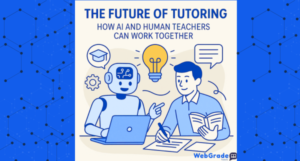
AI Learning Tools and human teacher collaborating with student using interactive learning tools in a modern classroom helping Advance Technology, Math AI, Use of AI in Science and Use Of English AI.
Uncategorized
WebGrade Tutors

How Interactive AI Learning Tools and Human Teachers Work Together

How AI And Human Teachers Can Work Together With AI Learning Tools Benefits and the Impact on Student Have you ever wondered if computers will replace your child’s teacher with the use of AI Learning Tools? Or maybe you’re asking, can technology really make learning more fun and effective? The truth is far more exciting. In today’s world, learning is changing fast — kids are using computer-based interactive AI learning tools to solve math problems, write stories, and study new languages. Meanwhile, parents and educators wonder how AI And Human Teachers Can Work Together.Actually, the future of learning isn’t about choosing between computers and human teachers. It’s about combining them to create a learning experience that is more personal with How AI learning tools And Human Teachers Can Work Together, more accessible, and more effective than either one could achieve alone.In this guide, you’ll discover how computers and human teachers are already working together, why this partnership helps students of all ages, and what this means for families seeking the best learning support with interactive learning tools today. How Technology is Changing School With AI Learning Tools Technology is transforming how students learn and how teachers teach. Here are some big indicators: A large percentage of students are using interactive learning tools every day. The AI learning Tools technology industry is projected to be worth hundreds of billions of dollars soon. Most teachers say that technology has improved their teaching. Students who use computer-interactive AI learning tools often improve their problem-solving skills significantly.All of this shows that computer-enhanced learning is becoming mainstream. But the numbers don’t tell the whole story —How AI And Human Teachers Can Work Together, but the human part of education remains critically important. What AI Learning Tools Do Really Well Here are some of the key ways computers shine in education: Help That’s Always There Computer-based learning systems are available 24/7. When your child studies late at night, a computer tool can provide explanations, practice problems, and step-by-step guidance. Learning doesn’t stop when daylight ends. AI Learning Tools Made Just for You Modern software tracks many indicators of how a student answers questions and interacts with material. This data enables systems to tailor practice problems and lessons to meet each learner’s exact needs. Quick Feedback and Testing AI Learning Tools can give instant feedback—not just marking right or wrong, but diagnosing misconceptions and guiding the student back on track immediately. Helping All Kinds of Learners Advance Technology supports students with different needs, such as translation tools, text-to-speech, visual aids, and adaptive interfaces. This means more learners can access quality instruction, no matter their style or background. Why Human Teachers Are Still Super Important Even with the power of computers, human teachers bring indispensable qualities that machines can’t replicate: emotional insight, creativity, mentorship, and real-life connections. Understanding Feelings and Getting Students Excited Imagine a student struggling with calculus: the computer sees the wrong answers; the teacher sees the frustration and lack of confidence behind them. The teacher intervenes not just with more practice, but with a chat, encouragement, or a shift in approach. Creative Problem-Solving and Real-Life Connections AI Learning Tools might generate endless practice problems, but human teachers can link these problems to a student’s interests and the real world—making learning memorable and meaningful. Long-Term Help and Goal Setting Teachers support students beyond just subject matter: they help set goals, plan study habits, manage time, and steer toward college or career decisions. Being Flexible When Life Happens When students face personal challenges, a human teacher can adapt: shift focus, offer emotional support, or change pace. A computer simply can’t do that with How AI And Human Teachers Can Work Together. In Future How AI And Human Teachers Can Work Together The best modern learning systems bring computer analytical power and human insight into a unified workflow. Here is a typical three-step approach: Step 1: AI Learning Tools Analysis & PreparationBefore a tutoring session, computer systems analyse the learner’s recent results, pinpoint strengths and weaknesses, and prepare data that the teacher will use. Step 2: Human-Led Interactive LearningIn the live session, the human teacher uses insights from the computer system, adapts instruction to the student’s current mood and style, explains hard concepts, and motivates the student. Step 3: Computer-Supported Practice Between SessionsAfter the live class, the computer provides targeted practice, tracks progress, and feeds back into the next cycle. This cycle enables efficient use of both How AI and Human Teachers Can Work Together. How This Works in Different School Subjects Math AI and Use Of Science AI Computers excel at generating and checking lots of practice problems, but the human teacher focuses on the why: concepts, strategies, connections to reality. Activity Tip: Have your child use a computer maths tool to solve five algebra problems, then explain their reasoning to you or another person. This combines How AI and Human Teachers Can Work Together. Reading and Writing With the Use Of English AI Computers can check grammar and provide suggestions; a human teacher guides interpretation, analyses literature, develops creative writing skills, and promotes deeper thinking. Foreign Language Learning AI Learning tools support pronunciation, vocabulary practice, and immersion; human teachers handle conversation practice, cultural context, and nuanced communication skills. Activity Tip: Use a language app for vocabulary, then do a 10-minute conversation using AI Learning Tools’ new words. Combine tech + human interaction. Answering Common Worries About AI Learning Tools in Education “Will computers make human connection less important?”Research shows the opposite: students using AI Learning tools often desire more human interaction to make sense of the information. Computers free up the teacher to focus on higher-level mentoring. educationnext.org+2hechingerreport.org+2 “Can we trust computers with our children’s learning?”The key is supervision and partnership, not replacement. Quality programs use computers as tools under the oversight of trained human teachers. “What about screen time and technology addiction?”Modern educational interactive AI learning tools are designed for purposeful learning—not aimless engagement. Combined with human teaching, they can actually reduce total screen time by

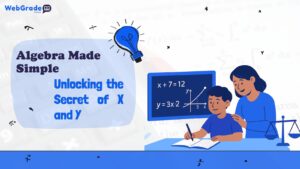
A WebGrade Tutors instructor helps a student master algebra made easy concepts, explaining variables and equations on a chalkboard to build confidence in algebra and solve for X and Y.
Uncategorized
WebGrade Tutors

Algebra Made Easy: Unlocking the Secrets of X and Y

Algebra Made Easy: Unlocking the Secrets of X and Y Last Tuesday evening, I watched Sarah stare at her homework with the familiar look of defeat. “Mom, why do they put letters in math now?” she asked, her voice trembling with frustration. If this scene sounds familiar, you’re not alone. Every year, thousands of students hit what I call the “algebra wall” – that moment when numbers suddenly mix with letters, and everything feels impossibly complex. But here’s what I’ve discovered after helping hundreds of families: algebra isn’t the enemy. It’s one of the most practical and powerful tools your child will ever learn. The secret is understanding that algebra is simply arithmetic with a mystery to solve. Whether you’re a parent watching your child struggle, a student feeling overwhelmed by variables and equations, or a teacher looking for fresh approaches to make algebra accessible, this guide will transform how you think about X and Y forever. You’ll learn how to approach algebra made easy, build confidence in algebra, understand variables and equations, and help your child solve for x and y with clarity. By the end of this article, you’ll understand why mastering algebra made easy builds confidence that extends far beyond math class—and how the right support can turn your child’s biggest academic challenge into their greatest strength. Why Students Struggle with Algebra Made Easy The Real Reason Students Struggle From working with hundreds of families, I’ve identified the core issue: most students hit algebra before they have a solid foundational number sense. It’s like trying to build a second story when the first floor isn’t finished. They see letters in math and think “variables and equations” must be scary. For example: 12-year-old Marcus came to me “failing algebra.” We discovered he couldn’t fluently work with fractions or confidently solve multi‐step arithmetic. No wonder his algebra equation felt impossible—he was trying to solve for x and y while still struggling with basic operations. Reframing Algebra Made Easy: It’s Detective Work, Not Magic I tell every student: algebra is detective work. You’re given clues (the equation) and your job is to find the missing number (the variable). Once students understand this framework of variables and equations, everything changes. Consider this simple equation:x + 7 = 12Instead of seeing mysterious symbols, students learn to think: “What number plus 7 equals 12?” Suddenly, the abstract becomes concrete, and problem‐solving becomes a logical process rather than guesswork. This is the heart of algebra made easy. The Confidence Factor Here’s something many explanations miss: confidence is the biggest predictor of success in algebra. Students who believe they can solve problems approach challenges differently than those who feel defeated before they start. I’ve watched students go from “I’m not a math person” to “Let me try a different approach” simply by experiencing early success with foundational concepts. That shift in confidence changes everything—and makes algebra made easy truly possible. Understanding Variables and Equations: The Building Blocks of Algebraic Thinking What Variables Really Represent When you hear “solve for x and y,” what does it mean? Variables are placeholder symbols that represent unknown quantities. Think of them as empty boxes waiting to be filled with the right number. When I explain variables and equations to younger students, I use the “mystery box” approach: Put 5 toys in a box and close it. Ask: “If there are X toys in this box, and I add 3 more, how many toys will we have total?” The equation becomes: X + 3 = (total toys) When we open the box and count 5 toys, we discover X = 5. This concrete experience helps students understand that variables and equations aren’t abstract—they represent real quantities we’re trying to figure out. It’s a key step toward algebra made easy. Real-World Variable Examples That Make Sense Connecting variables and equations to everyday life dramatically improves understanding: Shopping Scenario: “If a shirt costs $25 and you have a coupon for $5 off, how much will you pay?” Equation: Final cost = 25 − 5 = $20.Now add mystery: “If a shirt costs X dollars and your coupon saves $5, what’s the final cost?” Equation: Final cost = X − 5. Time and Distance: “If you walk 3 miles per hour for 2 hours, how far do you travel?” Equation: Distance = 3 × 2 = 6 miles.With variables: “If you walk at X miles per hour for 2 hours, how far do you travel?” Equation: Distance = X × 2 or Distance = 2X. These examples make variables and equations concrete, helping students tackle solve for x and y problems with confidence. Common Variable and Equation Mistakes and How to Avoid Them Mistake 1: Thinking X always equals the same number. Reality: X can represent any unknown quantity. Mistake 2: Assuming variables are more complicated than numbers. Reality: Variables follow the same mathematical rules as numbers. Mistake 3: Trying to guess the variable’s value instead of using a systematic process. The real path to algebra made easy is using structured steps to solve variables and equations. Mastering Equations: The Heart of Algebraic Problem Solving The Balance Scale Method That Actually Works One of the most effective analogies for teaching variables and equations is the physical balance scale. Imagine a perfectly balanced scale with weights on both sides. The equation represents that balance. Rule 1: Whatever you do to one side, you must do to the other.Rule 2: Your goal is to isolate the variable on one side. Example:x + 7 = 15Step 1: Identify what’s “attached” to x (the +7)Step 2: Remove it from both sides (subtract 7)x + 7 − 7 = 15 − 7 → x = 8Check: Does 8 + 7 = 15? Yes! This systematic approach makes solving variables and equations much more intuitive—key to algebra made easy. Progressive Equation Solving Skills Level 1: One‐Step Equations x + 5 = 12 → subtract 5 → x = 7 4x = 28 → divide by 4 → x

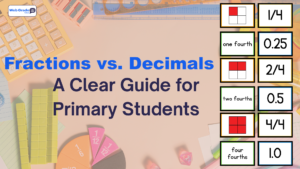
Illustration comparing fractions and decimals with visual math examples, showing how private tutoring helps primary students master fractions vs decimals.
Maths
WebGrade Tutors

Fractions vs Decimals: 5 Simple Ways to Turn Math Struggles Into Success

Fractions vs Decimals: A Friendly Parent-Guide for Primary Students Why This Topic Matters for Parents and Students If you’ve ever sat at the dining table watching your child stare at a math problem, you’ve probably heard the question: “Why can’t fractions and decimals just be the same thing?” For many children, the leap from whole numbers to fractions and decimals feels like stepping into a new language. Parents worry about: Exam performance is slipping because of confusion. Loss of confidence in math at an early stage. How to help when even you haven’t thought about fractions in years. This guide will break down fractions vs decimals in a clear, friendly way. You’ll see real-life examples, fun explanations, short 10-minute exercises, and how online private tutoring can make these tricky topics feel simple. Why It Matters for Parents What is a fraction? A fraction shows a part of a whole. When we say ¾, we mean three pieces out of four equal pieces. What is a decimal? A decimal also shows a part of a whole, but uses tenths, hundredths, thousandths (parts out of 10, 100, 1000). For example 0.75 means 75 out of 100, which is the same as ¾. You’re still talking about the same “part of the whole”.In fact, math education experts note that decimals and fractions represent the same underlying concept of rational numbers. Why the confusion? Because the formats look different, children (and parents!) often feel they’re two entirely separate things. But they’re not. Being able to switch between them builds strong number sense and avoids misunderstandings later on. Why it matters for you as a parent Helping your child understand fractions vs decimals in our online private tutoring classes isn’t just about sitting through homework. It’s about building confidence, avoiding early fears of maths, and making sure they don’t stumble when concepts get trickier. Research shows that a weak foundation in these areas is one of the biggest hurdles in higher-level math. Fractions vs Decimals Explained Simply The fraction language Top number (numerator) = how many parts you have. Bottom number (denominator) = how many equal parts the whole is divided into.For example, in ⅖: you have 2 parts out of 5 equal parts of the whole. The decimal language The decimal point separates whole units from parts of a unit. Digits after the decimal point represent tenths (0.1), hundredths (0.01), thousandths (0.001) etc.For example, 0.25 means 25 hundredths, which is the same as ¼. Converting fractions into decimals A handy method is: divide the numerator by the denominator.Example: ¾ → divide 3 ÷ 4 = 0.75 → so ¾ = 0.75 in decimal form. Why they match Because both are describing “parts of a whole” — just different ways of writing it. One uses the line (fraction) and one uses place value (decimal).According to Britannica: “In everyday mathematics there are two types of fractions, common and decimal … they express the same amounts.” Real-Life Examples of Fractions vs Decimals for Primary Learners Every day anchor: pizza or cake Slice a pizza into four equal slices. If you eat one, you’ve eaten ¼ of the whole pizza.In decimal form: ¼ = 0.25 (twenty-five hundredths).Using coins or money: 50 cents is half a dollar → ½ = 0.5 in decimal form. Grocery modelling Imagine a toy on sale at 50% off. 50% means half, which is ½ as a fraction, or 0.50 as a decimal.Using measuring cups: “This cake mix needs ½ a cup” helps visualise ½ = 0.5. Money connection When your child sees $3.75 at a shop, you can show that $3.75 = 3 and 75/100 of a dollar, or 3.75 = 3 + 0.75. And 0.75 = ¾.Using everyday contexts like money and cooking helps children link fractions and decimals in a meaningful way. Practical Tips for Teaching Fractions vs Decimals at Home Tip 1: Bring the lesson to wherever you are At the grocery aisle: “See that toy that’s 50 % off? That’s ½ the price, which equals 0.5 of the original amount.” In the kitchen: “This cookie mix needs ½ cup – that’s the same as 0.5 of a full cup.” Tip 2: Use consistent vocabulary Keep repeating: “fraction”, “decimal”, “part of the whole”. Asking your child: “Is this a fraction or a decimal? How do they link?” helps build fluency. Tip 3: Daily quick drills Short, consistent practice beats the occasional long session. Ten minutes a day helps build recognition and conversion skills without fatigue. Tip 4: Use physical models Bars, pizza slices, measuring cups, coins – tangible items make the abstract concrete. The research emphasizes that manipulatives help children grasp fractions and decimals better. Fun Math Activities for Kids to Master Fractions vs Decimals Activity: Fraction-Decimal Match Create cards: some show fractions (½, ¾, ⅖, ⅘, ⅛) and some show decimals (0.5, 0.75, 0.4, 0.8, 0.125). Shuffle and have the child pair the fractions with their decimal equivalents. Repeat until they can do it fast. Activity: Decimal Detective “Bought 75 cents of candy — how much of a dollar is that as a fraction?”Answer: 0.75 in decimal → that’s the same as ¾ in fraction form. Activity: Pizza Night Challenge Cut a 12-inch pizza into 8 slices. Ask: “If you eat 2 slices, what fraction of the pizza is left? What decimal is that?”2/8 left = ¼ left = 0.25.These playful, short activities build both fluency and confidence. The Role of Private Tutoring in Mastering Fractions vs Decimals Why one-to-one help matters When a child repeatedly struggles with “fractions vs decimals”, their confidence takes a hit. A tutor can personalize instruction: identify whether the struggle is with understanding the fraction format, or the decimal place-value format, or the conversion step. Research indicates that a strong foundational understanding of fractions and decimals supports later success in algebra and higher-level mathematics.  Online private tutoring versus in-person Online private tutoring offers flexibility: evenings, Saturdays, no commute. Many tutoring providers show that children who once stalled at conversion tasks (e.g., ¾ ↔

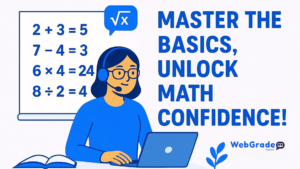
Student learning with Webgrade Tutors to solve math problems using basic operations—addition, subtraction, multiplication, and division—to overcome math challenges.
Maths
WebGrade Tutors

Master Basic Operations: Your Complete Guide to Math Success with WebGrade Tutors

Learning Basic Math Operations: A Helpful Guide to Your Math Success! Have you ever wondered if math speaks a foreign language? For example, are the numbers having a private discussion that you’re not invited to? You’re definitely not alone! Like you, many students sometimes feel a little confused about the basics. Well, guess what? Your math superpower is actually the “basics”: addition, subtraction, multiplication, and division! They’re the basic building blocks of all other math courses, including calculus and algebra. Think of WebGrade Tutors as your one-on-one tutor, available to help you every step of the way! This guide will make these basic math operations tasks clear, concise, and even a little fun. We want you not only to understand them but also to become their true masters and gain confidence in yourself. By the time you finish it, you will be smiling as you tackle easy math problems and be ready to take on any math challenge. Let’s explore the realm of basic math skills and master basic math together. The Art of Bringing Things Together: Addition Okay, let’s start with addition! You might be asking yourself, “More? That’s easy!” You might be right. However, it’s not just a positive gesture. Basically, addition is the process of joining groups, merging items, or calculating a total. Suppose your friend offers you two extra apples, and you already have three. How many do you have now? Addition in motion, that is! The goal is to find the sum of two or more numbers. What is addition, really? Addition enables us to understand quantities when they are combined in ways that go beyond simple counting. It’s like building something larger from smaller components. The basic concept is the same whether you’re adding a large or small number: You’re increasing the total value. You use this basic math operation every day, perhaps without even realizing it. Simple Addition Techniques: Having a few techniques up your sleeve is essential for learning addition effectively. The following addition techniques will help you connect numbers with ease to solve the math problems. Counting On: This is quite beneficial for beginners! This is super helpful for beginners! If you have 5 and you want to add 3, you can start at 5 and count on: 6, 7, 8. Simple, right? Number Bonds: Think about numbers as having partners; for example, combine 1 and 9, 2 and 8, 3 and 7, etc., to make the number 10. Understanding these pairs can help you add more quickly. Do you remember the hundreds, thousands, or tens? They are added in the ones (3+5=8) and tens (2+4=6). When you add numbers like 23 + 45, you get 68. It’s like organizing your numbers into neat columns before you add them up in a math challenge. Furthermore, regrouping, or carrying forward, is one of the first major hurdles. This happens when the total number of digits in a place value column is 10 or more. In a column, for example, adding 7 + 5 gives 12. 12 cannot be placed in a column! You put the 2 in a column and then carry the 1 (which means 1 ten) to the tens column. This is like exchanging ten single-dollar bills for ten-dollar ones; you’re just regrouping! Another often tricky word math problem is word problems. They resemble little math puzzles hidden within stories. The secret is to pay close attention to what you read and look for words that indicate addition, such as “total,” “in total,” “total,” “totally,” or “joint.” Chances are, if you encounter these words, you’re adding! Real-world addition: Textbooks aren’t the only source of information! You use it constantly. Have you ever planned your allowance? You estimate your total. Are you calculating ingredients in a recipe? You add teaspoons of sugar or cups of flour. It’s also an addition when you’re planning a trip and calculating the total number of miles you’ll cover! It’s all around you, making your life easier and more organized. Subtraction: Basic Math Operations After mastering the art of addition, let’s talk about its trusty companion, subtraction! Finding the difference between two numbers or determining how much is left after taking something away are the main purposes of subtraction. Suppose you eat three of the seven cookies you have(oops). How many are left over? That’s an example of subtraction! Understanding Subtraction: Subtraction enables us to answer questions such as “How much less?” and “How much more?” Since they are the opposite of addition, they cancel each other out. 3 + 4 = 7 if 7- 4 =3. Understanding this link is essential to truly understanding both functions. It is an essential mathematical function that helps with resource management and comparison of quantities. Smart Subtraction Techniques: A few smart subtraction techniques are included in learning subtraction effectively:  Counting Back/Up: If you are subtracting a small amount, you can count back. For 10 – 2, start at 10 and count back two: 9, 8. If you’re finding the difference between two close numbers, counting up can be easier. For 12 – 9, start at 9 and count up to 12: 10, 11, 12 (that’s 3 steps). However, it becomes natural with practice. Word problems play an important role in subtraction, just as they do in addition. Look for terms like “difference,” “how many are left,” “how many more,” “take away,” “minus,” or “remainder.” You can tell when it’s time to subtract by looking at these words! Borrowing (Regrouping): Ah, the infamous ‘bo* Borrowing (Regrouping): Many children get a little restless at this point, but it’s really just another way to reorganize, as if it were something else. When you’re subtracting a larger digit from a smaller digit in the same place value column (e.g., 3 – 7), you need to ‘borrow’ from the next place value column. For instance, if you have 3 tens and need to subtract 7 tens, you can ‘borrow’ 1 hundred (which is 10 tens) from the hundreds column, making your 3 tens

Fun and easy visual explaining fractions, decimals, and percentages created by math experts at WebGrade Tutors.
Maths
WebGrade Tutors

Fractions, Decimals, and Percentages: An Easy Way to Understand Their Relationships

Fractions, Decimals, and Percentages: An Easy Way to Understand Their Relationships Have you ever had the impression that Fractions, Decimals, and Percentages are all three separate languages used in the same math class? You’re not alone! Many students are confused about why these seemingly different ideas keep coming together. Like trying to decipher a hidden code, it can be somewhat challenging at times. Here’s a little secret, though: They’re not even separate! Think of them as alternate outfits for the same fantastic number. They’re really just three different ways of expressing the same value—pieces of a whole. A superhero dressed in three different costumes is still the same superhero. They’re just presenting themselves in other ways. That’s exactly what we’re discussing here! At WebGradeTutors, our goal is to make math fun, understandable, and even better. To help you solve the puzzle of fractions, decimals, and percentages and become a math expert, we’re here to serve as your helpful guide. We’ll show how they work together, how to transition between them with ease, and how knowing how they relate to each other can really make math a lot easier and less daunting. So let’s get started and turn that uncertainty into certainty! The Big Idea: It All Comes Down to Pieces of a Whole. Before we get into the details of how to convert numbers, let’s talk about the basic idea that unites fractions, decimals, and percentages: They all represent parts of a whole. Let’s say you have a delicious pizza that’s perfectly round. Now imagine cutting that pizza into eight equal slices. You’ve just witnessed the actions of our three math superheroes if you manage to catch three of those slices! As a Fraction: We write 3/8 because you ate 3 out of 8 slices. Simple, right? Simply put, a fraction is a clever way to show how many pieces you have compared to the total number. As a decimal: 3.375 is the result of dividing 3 by 8 (feel free to use a calculator if you want!) When dealing with topics like money or measurements, decimals are extremely helpful because they allow you to describe parts of a whole in a linear, easily comparable manner. Think of it as a more precise way to cut a pizza without having to count each piece with math fun . As a percentage: With the fancy ‘%’ sign, multiplying 0.375 by 100 gives 37.5%. The purpose of a percentage is to express parts of a whole in terms of one hundred. They’re great for making quick comparisons, like finding out how much of a discount your favorite video game is on! Therefore, you are always discussing the same quantity, whether you are discussing 3/8 of a pizza, 0.375 of a pizza, or 37.5 percent of a pizza. They simply present the same amazing truth in different ways. The first step in understanding these and many other mathematical ideas is to understand this fundamental link with math fun. Meet the Three Math Friends: Fractions, Decimals, and Percentages Made Simple Let’s now learn more about each of these three amigos, now that we’ve seen how they’re fundamentally connected and made math fun. The Original Part Teller: Fractions Fractions can sometimes feel a little intimidating because they’re often the first time students encounter parts of a whole. However, they’re just really honest! You can tell exactly what’s going on with a fraction like 3/4: You have three pieces out of four equal parts. The number on top (the numerator) indicates the number of pieces you have, and the number on the bottom (the denominator) indicates the number of parts that make up the whole. There are several types of fractions you may encounter: Proper fractions: 1/2, 3/4, 7/10, and other numbers where the top number is less than the bottom number. These are the most common and only represent a partial whole. Improper fractions: When the top number (such as 5/4, 7/7) is greater than or equal to the bottom number. They represent a whole number or more. Mixed numbers: A whole number plus a proper fraction, such as 1 1/2. These are just other ways of writing fractions incorrectly. Many children have some trouble, especially when it comes to adding or subtracting fractions. However, keep in mind that a fraction line really means “division.” Since 1/2 is just 1 divided by 2, it’s an easy way to represent division. Once you recognize them as friendly division problems, they’re a lot less scary! Decimals: An Economic Perspective In our everyday lives, decimals are the most common way we come across whole numbers, especially when it comes to money. Consider this: One dollar and fifty cents is $1.50. Fifty cents is equal to 0.50 of a dollar. We often use decimals without even realizing it! Place value is essential to understanding decimals. Each digit in a decimal has a unique value depending on where it is located, just like with whole numbers. For example, in 0.375: The 3 is in the tenths place (0.3) The 7 is in the hundredths place (0.07) The 5 is in the thousandths place (0.005) Decimals can be further explained by relating them to money. Consider dimes for the first digit after the decimal, pennies for the second, and so on. When adding or subtracting, it’s common to misplace decimal points or get confused with place values below the line. However, decimals are quite precise and easy to work with once you get the hang of them and made a student math expert. The “Per Hundred” Powerhouse in Percentages Percentages are everywhere! They’re a really practical way to convey parts of a total, whether it’s a deal at your favorite store (20% off!) or your test scores (you got 90%!). The word “percent” actually means “per hundred” or “out of one hundred.” 20%, then, is 20 out of 100. The ease with which percentages simplify comparisons is what gives them their power. Comparing 20% to 50% is much easier than

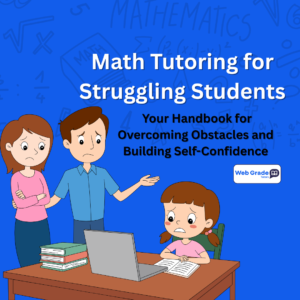
Illustration of a worried mother and father standing beside their child struggling with math homework on a laptop, representing math tutoring for struggling students with WebGrade Tutors
Maths
WebGrade Tutors

2025 Math Tutoring for Struggling Students: Overcome Math Problem And Math Anxiety

Math Tutoring for Struggling Students Your Handbook for Overcoming Obstacles and Building Self-Confidence Have you ever stared at a math problem and felt like you were trying to break an ancient code? I see it often—kids, teens, sometimes even adults gazing at pages of numbers, symbols, equations, and wondering, “Why won’t this make sense?” You are not alone. For many, the word math triggers a wave of anxiety, a feeling that they’re behind, or worse, that they’ll never catch up. Maybe you’ve heard your child whisper, “I’m just not a math person”, or watched them shut the book with a sigh while others seem to get it. It’s completely normal. But here’s the turning point: math doesn’t always have to feel impossible or overwhelming. With the right support—math tutoring for struggling students—those confusing symbols and tricky problems can start to make sense, and even become fun. In my years as a tutor, I’ve discovered what matters: building a strong foundation, understanding how the student learns, and transforming confusion into clarity one step at a time. Think of this guide as your roadmap: we’ll explore the fundamentals, address the common roadblocks, and demonstrate how personalized math tutoring can transform the entire experience. Whether you’re a parent worried about your child’s future or a student with math anxiety, thinking “When will I ever use this?”, you can rebuild both skill and confidence. Let’s begin. Why Math Tutoring for Struggling Students is Needed Imagine a classroom scene: the teacher speeds through a lesson, the textbook moves on, and your child still hasn’t fully grasped place value or how negative numbers work. They begin to whisper: “I’m behind.” Then fractions, decimals arrive, and everything feels harder. Before too long, they’re stuck in a loop of confusion, avoidance, and math anxiety. Here’s what I’ve uncovered in my tutoring sessions: A weak foundation in core skills − when place value, negative numbers, or the four operations are shaky, everything beyond suffers. Math anxiety – they think “I’m bad at math”, and that belief becomes a self-fulfilling prophecy. Lack of tailored help – the classroom pace or method doesn’t match their style, and they fall further behind. Relevance confusion – “When will I ever use this?” becomes a frequent question, and without a meaningful answer, they disengage. Research backs this: studies on high-dosage tutoring show that when math tutoring is consistent, small-group or one-on-one, the impact is greater than many other interventions. Education Commission of the States. Another study found that tutoring increased school attendance and engagement, showing it’s not just about content but about connection. FutureEd So remember: math tutoring for struggling students is not just about “catching up”. It’s about rebuilding confidence, fixing the root math problem, and making the subject meaningful again. If you’re thinking, “My child is falling behind and losing confidence,” or you’re a student muttering, “I can’t keep up,” this article is written for you. By the end, you’ll see what’s blocking progress, how targeted math tutoring can help, and what you can do about it. Strengthening Core Math Tutoring Skills Let’s roll up our sleeves and dive into the foundation. Because math tutoring for struggling students begins here. Without a firm foundation, everything else will feel like walking on sand. Let’s look at the essential blocks and how to reinforce them. Understanding Numbers and Operations: The Bedrock of Mathematics Remember when you first learnt tens, hundreds, thousands (or you watched your child struggle with it)? That’s not just a childhood memory. Place value is the unsung hero of all math. It tells you the ‘2’ in 20 is very different from the ‘2’ in 200. Without that clarity, every calculation becomes shaky and full of little errors. Try this 10-minute challenge:Write down 4,372. Ask: “What’s the value of the ‘4’?” Then change it to 4,072 and ask: “How did the number change?” Replace a digit with 0 and ask again. This builds number sense. In math tutoring sessions, I’ve seen this kind of number-sense work pay off big time—students who previously guessed now can reason. Also, the four operations—addition, subtraction, multiplication, division—are mastered only when students know when and why to apply them, not just execute steps. In math tutoring, I focus on why a method works, so that students begin to own the process rather than rely on memorization. How Positive and Negative Numbers Work in Real Life Negative numbers don’t just live in textbooks. They show up as debts, temperatures below zero, and floors in basements. I remember a 14-year-old saying, “Why is negative times negative positive?”. I used a metaphor: moving backward twice can move you forward. Or think of a debt canceled out by another debt. Seeing meaning makes the rule stop being weird. In my tutoring sessions, we use number lines, real-life scenarios (bank account with –£50 then +£30,) and reasons behind the rules. A frequent stumbling block is sign errors like treating 5 − (-3) as something else. Once students visualize, it stops being spooky. Mastering the Four Operations: Beyond Memorization Yes, you memorized the times tables or did long division. But mastery means being able to flexibly apply them: estimate, judge reasonableness, do mental math, and reduce reliance on the calculator. For many students, the over-dependence on calculators builds a silent math problem: they know the button, not the idea. Try this 5-minute warm-up: Without a calculator, estimate 39×4. Then compute exactly. Ask: “Is the result plausible if I estimated 40×4=160?” This builds fluency. In math tutoring, I aim to reduce the number of times a child reaches for a calculator for simple tasks. BODMAS / PEMDAS: The Easy Guide to Order of Operations Ever seen 2 + 3×4 and thought “Add or multiply first?” That confusion happens when the order of operations is unclear. That one mistake can ruin otherwise correct calculation skills. In tutoring, I frame it like a recipe: you don’t add the icing before the cake is baked. We practice layered expressions like 5 + (2×3)−,4, then add brackets and exponents.