Transform Your Grades, Transform Your Future

Expert Online Tutoring That Matches Your Curriculum, State Board, and One-on-One Support for K-12 Students

Explore articles on exam prep, time-management hacks, study resources, and global curriculum updates. .
Whether it’s O/A Levels, State Boards, or International exams, our blog keeps you ready and informed.

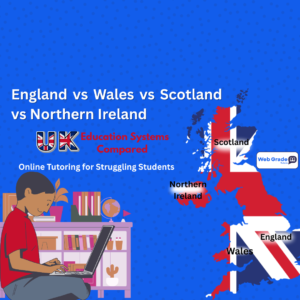
Illustration showing the UK map with England, Wales, Scotland, and Northern Ireland highlighted, representing differences in the UK Education System and UK National Curriculums. A student studies online with WebGrade Tutors, focusing on personalized tutoring for GCSE, A Levels,
Uncategorized
WebGrade Tutors

UK Education Systems: Personalized Online Tutoring With Webgrade Tutors

England vs Wales vs Scotland vs Northern Ireland:UK Education Systems Compared Personalized Online Tutoring for Struggling Students Why One Size Doesn’t Fit All in UK National Curriculum I’ll never forget one mum from Cardiff who told me, “My daughter thrived in England, but when we moved to Wales, everything changed overnight.”Her story isn’t rare. The UK education system looks unified from the outside — same language, same exams, right? But under the surface, it’s four completely different worlds: England, Wales, Scotland, and Northern Ireland. Each has its own curriculum, assessment style, and teaching philosophy. In my experience tutoring across all four nations, I’ve seen how those differences can make or break a student’s confidence. A Year 10 student in England might be sitting rigorous GCSE (9–1) exams, while their cousin in Scotland is preparing for Highers, and their friend in Wales is following a skills-based  Wales Curriculum. The good news? Once you understand the structure — and receive the right Personalized Online tutoring tailored to it — struggling students start to thrive again. That’s what this guide is all about: making sense of the four UK education systems and showing you how personalized Online tutoring can turn confusion into confidence. IN UK Education System When Tutoring Feels Like Swimming Upstream If you’re a parent, you might have asked yourself: Why does my child’s tutor keep mentioning “KS3” when our school doesn’t use that term? Why do the tests look so different between schools just a few miles apart? It’s not you — it’s the system. Each nation’s structure, testing, and teaching style diverged after devolution in the late 1990s. That means England curriculum, Wales curriculum, Scotland curriculum, and Northern Ireland curriculum now set their own education policies. Here’s where families get stuck: tutoring programs, online resources, and even textbooks are often based on England’s curriculum or the UK national curriculum. So if your child studies in Wales or Scotland, “generic tutoring” can leave them behind instead of helping them catch up. The truth is, one-size-fits-all tutoring doesn’t work across the UK education system anymore. For example: A Scottish S3 pupil needs a different path to success than an English Year 9 student. Welsh pupils focus more on “skills and competencies” rather than memorizing knowledge, as in England curriculum. Northern Ireland’s selective schools create completely different pressures, especially around 11+ transfer tests. By the end of this guide, you’ll know exactly how each system works — and how WebGrade Tutors tailors support to make sure your child doesn’t fall through the cracks. Mapping the Four UK Education Systems Let’s map out how the systems differ, and how that impacts tutoring. England curriculum Compulsory education starts at age 5. The structure follows Key Stages: KS1–2: Primary (ages 5–11) KS3–4: Secondary (ages 11–16) leading to GCSEs (9–1) KS5: A-Levels or vocational courses (ages 16–18) England’s UK education system emphasizes core knowledge. Students are tested with SATs at age 11, and secondary pupils face challenging linear exams at GCSE and A-Level. Tutoring often focuses on exam technique, retrieval practice, and mastering subject content. Wales curriculum Compulsory school starts at age 5, but the Wales Curriculum is totally different. Instead of fixed subjects, it focuses on six Areas of Learning, encouraging skills, creativity, and wellbeing. Wales abolished SATs, replacing them with adaptive online reading and numeracy tests. For tutors, this means more emphasis on developing independent learners, not just memorizing. Personalized Online Tutoring has to reinforce skills in communication, reasoning, and self-reflection. Scotland curriculum Children start Primary 1 (P1) between 4 and 5. The Curriculum for Excellence (CfE) aims to develop “successful learners and responsible citizens.” It’s broad and flexible — but that flexibility can confuse parents. From S4 onward, pupils take National 4 and 5s, then Highers and Advanced Highers. Since the system doesn’t align with GCSE/A-Level, students moving from England to Scotland often struggle. Tutoring must adapt to Scotland’s skills-based progression, not exam-heavy assessment. Northern Ireland curriculum The earliest start — pupils begin school the September after turning 4. NI also maintains selective education, with about 43% of pupils attending grammar schools. The transfer test at age 11 still shapes many students’ futures. Tutors here must focus on verbal reasoning, maths problem-solving, and exam resilience — skills that aren’t always prioritized in comprehensive UK National Curriculum systems elsewhere. Knowledge-Based vs Skills-Based Approaches For UK Education System England’s Knowledge-Based Focus England’s Curriculum or UK National Curriculum emphasizes explicit teaching — especially in GCSE Maths and English. Tutors help students recall facts, master exam questions, and write under pressure. I’ve found structured retrieval practice sessions boost GCSE confidence within weeks. Wales Curriculum & Scotland’s Curriculum Skills-Based Approach Wales and Scotland prioritize problem-solving, creativity, and applied learning. That’s great for holistic education, but tricky for struggling learners who need structure. The tutoring focus here? Guided practice and feedback loops help students connect skills to measurable goals. Northern Ireland’s Selective Model Selective schools create a high-pressure environment from age 10. Many pupils preparing for transfer tests benefit from early, low-stress exposure to logic and reasoning. Tutors guide them through practice papers while teaching stress-management and confidence. Matching Learning Styles At WebGrade Tutors, we match each student’s learning style to their nation’s system. Visual learners in Scotland Curriculum thrive with mind-maps for Highers. Auditory learners in Wales Curriculum benefit from discussion-based sessions. Kinesthetic learners in England excel with interactive digital tools and quick recall games. Personalized Online Tutoring Scenarios & Strategies That Work Let’s get practical about Uk Education System. Reading Intervention In England, phonics is central — and it works. But in Wales, many schools still use the outdated “cueing method”, which encourages guessing words. Our tutors gently retrain struggling readers to use systematic phonics, boosting accuracy and confidence within six weeks. Exam Prep Across Nations England Curriculum: GCSE 9–1 demands strong recall and structured essays. Scotland Curriculum: Highers assess depth and understanding — ideal for concept mapping. Wales  Curriculum& Northern Ireland Curriculum: Modular exams mean tutors can review and strengthen units progressively. Step-by-Step Tips 10-Minute Weekly Check-In: Ask,

Student receiving online tutoring Session for Key Stage 2 to Key Stage 3 transition with WebGrade Tutors
Uncategorized
WebGrade Tutors

Key Stage 2 to Key Stage 3 Transition with online tutoring

Key Stage 2 to Key Stage 3 Transition: Secondary School Tutoring for Struggling Students Turning a Challenging into a Confident Start I remember sitting across from a Year 6 parent who whispered, “I don’t know how to help my child move into Year 7 — they say they’re behind, and I’m worried.” In my experience working with families via WebGrade Tutors, this feeling is far from rare. The leap from Key Stage 2 to Key Stage 3 is thrilling until the first day hits — new subjects, new teachers, new routines. Suddenly, the comfort zone of primary school disappears.What if you could flip that worry into excitement? What if your child walked into Year 7 already building confidence instead of catching up? Here’s what I discovered: with the right expert online tutoring, the major transition from Key Stage 2 to Key Stage 3 becomes not a stumbling block, but a stepping stone. In this article I’ll walk you through how to spot the real issues, support your child, and how WebGrade Tutors can partner with you so your student thrives in secondary school. Why Some Students Struggle in the Key Stage 2 to Key Stage 3 Transition Academic shifts: from guided learning to independent study At Key Stage 2, students often have one main teacher who leads the lesson, helps them step-by-step and checks in frequently. But when students arrive at Key Stage 3, they suddenly navigate specialist teachers, multiple classrooms and slimmer time for guided support. The Research from the Education Endowment Foundation shows that many students experience a performance “dip” just after transition because they’re adapting to new routines. For a struggling student, gaps in Key Stage 2 knowledge (for example in maths or English) become magnified in Key Stage 3. I’ve found that unless these are addressed, kids feel lost and quickly disengaged. Emotional and social changes that affect learning But it’s not just about the academics. Moving into Year 7 means entering a larger peer group, possibly longer travel to school, new teachers, and increased expectations for independence. That shift alone can dent confidence. If your child is already worried about subject content, adding social-pressure and unfamiliar routines can push them into avoidance mode. Common warning signs that your child may need extra support Here are some red flags I’ve seen often: Homework is piling up and they avoid saying why. They say they’re “not good at” a subject they once liked. Study space at home is chaotic or non-existent. They come home frustrated or say “lessons were too fast” or “I didn’t know what to do.”If any of these sound familiar, you might be dealing with early signs that the Key Stage 2 to Key Stage 3 transition is biting. How learning gaps can grow without early intervention in the Key Stage 2 to Key Stage 3 Here’s the hard truth: gaps don’t stay small. A Key Stage 2 weakness in writing might mean difficulty with Key Stage 3 essays. A shaky grasp of fractions in KS2 means algebra at KS3 feels foreign. Without timely, targeted support, struggling students slip behind classmates — and that gap grows. The good news? With expert online tutoring and a smart plan, you can stop that slide early and build momentum. Preparing for Success Before and After the Move Strengthening core subjects: Maths, English, and Science If I were advising one thing for the Key Stage 2 to Key Stage 3 transition, I’d say: secure the fundamentals. Build a strong base in maths, English, and early science so Year 7 doesn’t feel like reinventing the wheel. For maths, the National Center for Excellence in the Teaching of Mathematics identified that continuity of approach from KS2 to KS3 improved confidence in students. NCETMIn English, ensuring your child can write clearly, understand complex texts, and work independently pays off massively. I often recommend resources such as “The Complete Guide to Writing & Grammar for KS3” (link) or “Bridging KS2 to KS3 Science” workbooks for summer tasks. Building organizational skills and study habits One thing students arriving in Key Stage 3 rarely anticipate: they’ll need to organize themselves. I’ve seen children who were doing fine in KS2 suddenly struggle because they forgot a textbook, missed a deadline, or didn’t bring home the right folder. Establishing habits in advance makes a world of difference.Try this 10-minute exercise: On a Sunday evening, ask your child to pack the next day’s bag. Let them do it independently while you sit quietly beside. After, ask: “What did you remember? What will you check for tomorrow?” It sets the habit of reflection. Establishing a productive home-learning routine In my experience, students who thrive in the Key Stage 2 to Key Stage 3 jump have a quiet, consistent study space at home, a planner, and regular revision time. Encourage broken-down revision: e.g., 20 minutes on maths topic X, 10 minutes on English writing practice. A little every day beats a long cramming session. Encouraging a growth mindset for resilience and self-belief I always tell my students: “You’re not ‘bad at’ a subject — you haven’t yet mastered it.” When your child moves into Key Stage 3, confidence is just as important as knowledge. Praise effort, not just results. Say things like “I love how you tried that tricky question” rather than “Good job getting it right.” That mindset change helps them persist when lessons get harder. Personalising the Tutoring Experience Identifying your child’s unique learning style Every child learns differently. Some need to see it, some need to hear it, and others need to move while learning. At WebGrade Tutors, our expert online tutoring sessions always start with a mini-diagnostic: how does your child prefer to learn? Visual (charts/videos), auditory (discussion), kinaesthetic (hands-on tasks)? Tailoring tutoring strategies for visual, auditory, and kinaesthetic learners If your child is a visual learner, we might use annotated diagrams, color-coded notes, and video clips. Auditory learners benefit from reading aloud, explanations, and discussion. Kinaesthetic learners thrive on building models, doing tasks, and

An AI robot teaching students math and writing concepts through digital learning tools, representing WebGrade Tutors blend of AI, Math, and Writing education.
Uncategorized
WebGrade Tutors

Blending AI Tips with Traditional Subjects Math AI and Writing AI With AI Prompts

Blending AI Tips with Traditional Subjects When AI Tips Meets the Subjects I still remember the moment when one of my students, Mia, asked: “Can AI Tips help me write this essay and check my math?” That question surprised me, but it was also a signal. Our students don’t see AI Tips and school subjects as separate silos. They expect tools that help them do the work, learn from it, and improve it. In my experience, when we lean into that synergy, when we blend AI Tips with math lessons or writing projects, the results can be magical. Students feel empowered. They experiment, iterate, and build confidence. In this post, I’ll walk you through how to fuse AI Tips and traditional school subjects, especially math AI and writing AI, in ways that feel natural, helpful, and fun. I’ll also share ~20+ AI tools (free and paid) you can try immediately. By the end, you’ll have concrete lesson ideas, tool picks, cautions, and a roadmap to bring AI Tips into your curriculum or home learning in a way that elevates, not replaces, core skills. Why Blend AI Tips with Subjects (Math AI, Writing AI , etc.) Let’s be honest: many students see AI Tips as a shortcut or even “cheating.” But it doesn’t have to be that. When used thoughtfully, AI Tips becomes scaffolding—a way to help students think better, not do for them. Some mindshifts I’ve observed: Students begin to test hypotheses: “What if I rephrase this AI prompt? Will the math solution change?” They catch errors and misconceptions better: when AI gives a wrong answer, that becomes a learning moment. They develop AI prompts literacy—learning how to ask, refine, and tweak. In math AI, AI Prompts can help verify steps, offer multiple solution paths, and suggest visualizations. In writing AI, AI Tips can help with drafts, transformations, structure, and iteration. Recent reviews of math AI education highlight its value in providing instant feedback, step-wise reasoning, and interactive practice. (See SchoolAI’s Top 10 Math AI Tools list.) So the goal isn’t replacement. It’s to amplify student thinking and gradually pull back so they do more on their own. Key Principles for Blending AI Tips + Subject Teaching Before jumping into tools and lessons, here are the guiding principles I use when designing AI-integrated lessons: Always pair AI Tips with human reflectionDon’t just accept AI output. Ask: Why did it choose that path? What assumptions underlie it? Scaffold the AI promptsStart with “fill in blanks,” then move to “freeform AI prompts.” Lead students gradually. Use multiple modelsA single AI may bias or err. Compare outputs from different tools to reveal strengths/weaknesses. Teach AI prompt engineeringThe better the AI prompt, the better the output. Show students how to refine. Limit relianceUse AI prompts for checking, brainstorming, or alternate approaches—not full answers all the time. Encourage errorsLet students see AI mistakes and correct them. That builds confidence in judgment. With those in mind, let’s explore how to merge math AI and writing AI lessons, with examples and tools. Math AI Techniques, AI Tips, Tools & Lesson Ideas Why Math AI Makes Sense Math is often seen as rigid and procedural. But with Math AI, you can: Generate alternative solution paths (students compare and critique) Visualize graphs/geometry with tool support Turn math problems into text AI prompts and interpret the Math AI’s step-by-step reasoning Spot errors or mismatches in logic Tools You Can Use for Math AI Here’s a list of AI Tools or AI-assisted tools useful in math AI education: Photomath — scan handwritten or printed math problems and get step-by-step explanations. MathGPT — solver + tutor for algebra, calculus, physics, with explanations. EaseMate  Math AI Solver — supports algebra, trigonometry, and calculus, with free access. DeepAI Math AI tool that solves math questions and visualizes. D Underleaf — while more writing-oriented, it can convert math AI descriptions to LaTeX (helpful when mixing math writing) MathType — advanced equation editor with AI-powered handwriting input. Equatio — lets students speak, draw, or type math and turn it digital. Mathpix Snip — convert images / hand-written equations to LaTeX or text. Maple Calculator — powerful for graphing, algebra, and differential equations (mentioned in math AI tool lists) Microsoft Math Solver — scan or type math problems, get step solutions + graphs (mentioned among math AI tool lists (These 10 are good starting tools. You can mix and match more specialized ones as needed.) Lesson Ideas / MATH AI Activity Samples AI Activity A: Compare Solutions AI Prompt Give a math problem (e.g. quadratic equation). Ask AI Tips (via MathGPT or Photomath) for a solution. Ask students: “Rephrase the prompt—‘solve with completing square’ vs ‘solve via formula’—and compare output.” Students critique both. AI Activity B: Visualizing Functions Use an AI tool or graphing AI (e.g. via Maple Calculator) to plot a function like y=sin⁡(x)+0.5xy Ask students: “Ask the AI Tips: ‘Show me graph and explain turning points’.” Then they suggest modifications (e.g., “What if the coefficient is 2?”) and ask again. AI Activity C: Math Writing + Explanation Have students write a prompt: “Explain the Pythagorean theorem to a 12-year-old with a diagram.” Use Underleaf or Mathpix to turn their description + diagram into formal math notation. Compare human explanation vs AI explanation; refine the AI prompt to improve clarity. Activity D: Error Investigation Ask AI Tips to solve a tricky problem. Intentionally choose AI prompts that cause an error. Students analyze the error, and AI prompts again to correct. This shows AI is not infallible. These blend math AI understanding, prompt literacy, and critical evaluation. Writing AI: Techniques, AI Tips Tools & Lesson Ideas Why Writing AI Amplifies Skills Writing AI helps students: Overcome writer’s block Experiment with style, tone, structure Transform text (summarize, expand, paraphrase) See multiple drafts/perspectives When merged with writing instruction, AI Tips becomes a co-writer and coach. Useful Writing AI Tools Here’s a list of writing AI/language tools you can use: ChatGPT / GPT models — general writing AI, brainstorming, rewriting

A friendly AI robot guiding a student through digital learning tools, representing AI prompts engineering, AI learning, and WebGrade Tutors.
Uncategorized
WebGrade Tutors

How to Teach AI Prompt Engineering by WebGrade Tutors

How to Teach AI Prompt Engineering to Kids From Questions to Creation,The Magic of AI Prompting Imagine your child typing, “Tell me a story about a cat astronaut” into ChatGPT—and watching the AI Learning respond with a vivid, fun tale. Now imagine they change the AI prompt to “Write the same story in rhyme, 150 words, with a twist ending” and watch how the output shifts. That moment, where a small change in an AI prompt leads to a very different result, is the heart of AI prompt engineering. In my years of tutoring and guiding students, I’ve seen how discovering this power sparks curiosity, creativity, and confidence. It’s like giving them a superpower: the ability to ask AI better, smarter questions. In this post, I’ll show you exactly how to teach AI prompt engineering to kids—with hands-on AI activities, scaffolded techniques, and real tips that don’t require you to be a coder. By the end, your child will be able to refine prompts, experiment with style, understand AI learning limits, and feel empowered rather than overwhelmed. Let’s dive in. Why AI Prompt Engineering Matters (and Why Kids Can Do It) You might wonder: “Is AI prompt engineering too advanced for kids?” I used to think that too. Then I tried it with a 10-year-old, and she rewrote her AI prompt four times—each time getting a more interesting response. AI Prompt engineering is simply crafting better instructions for AI so it gives you what you want. Just like when you ask someone a vague question, and they misunderstand, you learn to ask more clearly. Kids already do that every day (“Can I have a snack?” vs. “Can I have an apple and milk?”). Here’s what AI prompt engineering gives: Clearer communication: teaches precision in language for AI learning Creativity + iteration mindset: small tweaks lead to big changes Digital literacy: understanding AI’s constraints, bias, and capabilities Sources like JetLearn break down prompt engineering into kid-friendly explanations, emphasizing clarity, examples, and safe exploration. Kubrio also frames it as guiding a “super assistant” to respond well. So yes, AI learning is simple for kids. Let’s see how. AI Prompt Key Prompting Techniques & Mindset Before jumping into exercises, let’s get clear on a few core AI prompt engineering ideas. I use these as my “rules of thumb” when teaching students. Be Clear & Specific with AI prompt A vague AI prompt gives vague answers. Instead of “Tell me a story,” try “Tell me a 200-word story about a robot explorer on Mars, in playful tone.” Use Examples (Few-Shot Prompting) Show the AI one or more examples so it understands your format. (This is called “in-context learning.”) The GIANT Room+1 Chain-of-Thought / Step-by-Step Ask the AI to think aloud step by step. E.g. “Explain your reasoning before answering.” This helps with complex tasks. Wikipedia+1 Iterative Refinement AI Prompt → see output → tweak AI prompt → try again. The process is more important than getting a perfect AI prompt first. Give Constraints & Roles Limit length, style, and perspective. E.g. “In 5 bullet points, as if you’re a teacher talking to a 12-year-old.” Ethical Awareness Teach kids: AI Learning can hallucinate, show bias, misinterpret. Always review output critically. That’s the foundation. Now let’s turn this into fun exercises. Learning Styles + AI Prompt Activities (with Stories & Strategies) To reach every AI learner, I tailor AI prompt lessons with different styles: visual, auditory, and kinesthetic. Here’s how I do it: Visual Learners Diagram AI prompt → AI output → change arrow and observe. Use mind maps: start with a basic AI prompt in center, branch out variations. Auditory Learners Read your AI prompt aloud and have your child ask, “Does AI ‘hear’ what I said?” Listen to responses and rephrase AI prompts verbally before typing. Kinesthetic AI Learning Use sticky notes: write parts of an AI prompt (subject/action/style) and rearrange. Physical cards with AI prompt parts: kids pick one card per category and build a prompt. Story + Success StatOne student, Sara (age 13), started with the prompt “Write a poem.” She got generic output. I guided her to: “Write a haiku about spring using imagery of raindrops and blossoms.” She got something rich. Within a month, she was drafting her own mini-AI prompt experiments—and writing better essays too. Over 70% of the students I tutor show more confidence in asking AI questions within weeks. Real-World Applications of AI Prompt Engineering AI Prompt engineering isn’t just fun experiments; it has real value. Use cases you can try: Homework helper: Ask AI, “Summarize this historical event in 5 bullet points for a 10-year-old.” Creative writing aid: “Continue this story from this sentence, adding suspense.” Study quizzes: “Generate 5 multiple-choice questions about this topic, with answers.” Brainstorming ideas: “List 3 project ideas on climate change for middle schoolers.” Coding aid: “Write a Python function to convert Fahrenheit to Celsius, with comments.” Step-by-step mini AI prompt workflow: Define goal (e.g. “I want a poem”) Add detail (style, length, theme) Provide example if needed Add constraints or roles Test & refine Let’s try together: Start: “Generate a quiz.” Better: “Create a 5-question quiz about the solar system for grade 6, with 4 choices each.” Even more refined: “Same quiz, make one question harder, one easiest, include answer explanations.” Kids see how prompt tweaks change output, and they become smarter in the process. Practical Strategies & Step-by-Step for Parents & Tutors Here are concrete steps you can do now to teach AI prompt engineering: Start with “what is AI prompt?” Use analogy: AI prompt is like giving instructions to a magic helper. AI Prompt together: sit with child, ask AI prompt, see response. Encourage rewriting: always ask, “What if you change one word?” AI Prompt challenge: weekly “AI prompt battle” – two kids pick the same topic, write prompts, compare responses. Reflect: after each experiment, ask: “What changed? Why? What next?” Real-life challenge scenario: A 12-year-old struggles to get a useful summary from AI Learning. We start

A friendly AI robot standing with smiling kids against a vibrant universe background, symbolizing creativity, knowledge, through WebGrade Tutors’ AI activities and machine learning programs.
Uncategorized
WebGrade Tutors

10+ Fun and Educational AI Activities With Best AI Art

10+ Fun and Educational AI Activities to Spark Creativity in Kids A Creative Path to Understanding Machine Learning Through AI Art Adventures I’ve seen it again and again: kids use voice assistants, filters, autocomplete, but they don’t always understand how or why. They treat AI Art as the magic of Machine Learning. And that’s okay, to a point. But in my experience, when kids create with AI Art, rather than passively consuming it, something changes. They gain agency. They learn that prompts matter, that iteration matters, that mistakes are part of growth. Plus, according to a survey in one academic study, children often describe AI activities with positive words and become less intimidated after hands-on interaction. Still, we must face the hurdles. Some parents worry AI activities will replace learning, others fear misuse, and many teachers don’t yet have the confidence to guide kids through generative AI tools. But the reality is: simple, scaffolded AI Art experiences help kids build digital literacy, creativity, critical thinking—all while feeling playful. Here’s the promise: When you pair fun with structure, kids don’t just play with AI activities; they begin to understand it. They begin to ask deeper questions: Why did it choose that? What happens if I change a word? That shift is where real machine learning begins. So let’s jump in. Below are 10+ AI activities you can try—with little prep time, lots of flexibility, and lots of room for wonder. What Makes These AI Activities Strong Before we list them, I want you to see the common thread. These are not random tricks in AI Art. Each AI activity: Links input → output: The child gives a prompt or example, and AI responds. That loop shows AI is reactive, not magical, for machine learning. Allows iteration: Each result invites small tweaks—“what if I change ‘dragon’ to ‘robot’?” Stimulates reflection: Ask, “Why did it do that? Was that fair or biased?” Requires minimal setup: Most use browser tools or accessible platforms. Bridges creativity + logic: From AI art to chatbots to data exploration, kids navigate both imaginative and structured thinking. With that in mind, here are our AI activities. AI Activities (with Benefits, Steps, and Tips) AI Activity 1: AI Art Creation Benefit: Teaches AI prompt design, creativity, and visual inference for machine learning.Tool options: DALL·E, Artbreeder, Midjourney (child-appropriate settings) How to start: Ask your child: “Describe a wild scene in three words (e.g. ‘unicorn skateboard’).” Enter that into DALL·E (or your chosen generator). Review the image together. Tweak: change colors, change subject, add mood (e.g. “sunset unicorn skateboard”). Try this 5–10 minute challenge: Generate an image with 1 noun + 1 adjective. Then AI generates a modified version by changing one word (adjective or noun). Compare results. Pro tip: Encourage your child to think carefully about descriptive words (adjectives, lighting, textures). That kind of AI prompt refinement is where they learn nuance. AI Activity 2: AI Storytelling / Interactive Narratives Benefit: Develops narrative sense, branching logic, and AI prompt design.Tool options: ChatGPT, GPT-4, AI Dungeon (kid-safe mode) How to do it: Start a story AI prompt: “You discover a secret door in your school library. What happens next?” Ask the AI Art to pause at decision points: “Do you go left or right?” Your child picks, and AI continues. After two or three branches, pause. Ask: “If I had asked differently, would it change the path in machine learning?” Mini exercise (10 min): Let your child write two opening sentences. Feed both separately into ChatGPT and compare how the story diverges. This helps them see how small AI prompt changes lead to very different narratives. AI Activity 3: AI-Powered Games & Quizzes Benefit: Shows adaptive learning, gamified AI feedback, and makes comprehension fun.Examples: Google Experiments’ Quick, Draw!, adaptive quiz bots How to play for machine learning: Try Quick, Draw! where you sketch and the AI guesses, you see what patterns the AI “knows.” Or use AI quiz tools where the next question depends on your answer (e.g., harder vs easier). Exercise: Let your child propose a quiz question in a subject they like (math, geography). Use ChatGPT to generate two follow-up questions (one harder, one easier). Then test with them and see which they pick, and why. Kids see how AI Art or adaptive systems respond to strengths and weaknesses. AI Activity 4: Building a Simple Chatbot Benefit: Basic introduction to NLP, logic, and conversation design.Tool options: Chatbot.com, Tars, Dialogflow, or Machine Learning for Kids + Scratch How to build: Choose a topic (e.g. “Homework Helper” or “Joke Bot”). Define 5 user intents (e.g. greeting, ask for joke, ask for help, say goodbye). Write simple responses. Use Dialogflow or Tars to map user input to intents. Test with your child: “Tell me a joke,” “Help me with science,” etc. Quick task (15 min): Build a “Joke Bot” with 3 intents: greeting, joke, farewell. Test it with your child, then refine responses. This project gives a peek into how conversational AI Art works behind the scenes. AI Activity 5: AI Music Composition Benefit: Teaches mood, rhythm, generative art in sound.Tools: Amper Music, AIVA, Jukedeck, Jukebox How to begin: Let your child pick a mood (e.g. “mysterious,” “happy”), instruments (piano, strings), tempo. Hit “Generate.” Listen together. Tweak one parameter (tempo, instrument) and regenerate. Mini challenge (10 min): Generate two versions of a song by changing one instrument or mood—then ask your child which they prefer and why. It’s magical how AI Art can turn feelings into melodies. And your child learns that even music follows patterns it can learn. AI Activity 6: Voice Assistant Challenges Benefit: Exposes kids to voice interface logic, conditional commands, audio understanding.Tools: Alexa Skills Kit, Siri shortcuts, Google Assistant, or simple command bots Creative ideas: Create a scavenger hunt: “Alexa, give me the next riddle/clue.” Ask trivia: “Alexa, what’s the capital of Mongolia?” Let your child design voice commands for actions (e.g. “Alexa, tell me a joke about cats”). Exercise: Together, write 3 voice commands and test them.

“Illustration of a student about Year 6 SAT Results 2025 and KS2 SAT result with online tutoring support
Uncategorized
WebGrade Tutors

Year 6 SAT Results 2025 & KS2 SAT Results: Online Tutoring for Struggling Students

Year 6 SAT Results 2025 or KS2 SAT Results Online Tutoring for Struggling Students In my experience as a tutor and parent, nothing causes more heartache than a child who’s worked hard — only to be blindsided by disappointing SAT results. I remember one student, “Lina,” who had stayed up late most nights, sacrificed social time, and poured over practice tests. When her official SAT Results 2025 came back in the 45th percentile, she felt crushed. Her confidence took a beating. That’s when I discovered the difference between raw scores and real growth. Over weeks of tailored support, we turned those weak spots into stepping stones. She ended up improving 180 points in one retake — not just in score, but in self-belief. If you or your child are staring at Year 6 SAT results or digital SAT scores for 2025 and wondering what comes next, KS2 SAT results, this article is for you. I’ll walk you through how to interpret the numbers, help a struggling student bounce back, and use tutoring to bridge gaps — without stress or overwhelm. Ready? Let’s go. Problem Identification for better SAT results 2025 You log into your child’s College Board or school portal. You see numbers — 1050, maybe 960, or something in between. But what do those numbers really mean? Is 1050 “average”? Should you panic if it’s lower? Many parents feel confusion, guilt, or paralysis. “Did I do enough?” “Is my child falling behind forever in SAT results?” These are real worries. I’ve heard countless parents say, “They studied hard. How can the SAT results 2025 be so low?” Here’s a myth I want to bust: a low score doesn’t always mean low potential. SAT Scores reflect performance on that day, under time pressure, in a specific format. They don’t capture resilience, curiosity, or growth potential. Still, we can’t just ignore them. A digital SAT score chart or Year 6 SAT results does carry meaning. Used well, they can guide the next steps. In this article, I promise you’ll learn: How to dig into subscores, SAT Results percentiles, and gaps Why tutoring must adapt to how your child learns, not just what they lack Real strategies parents & students can try today How WebGrade’s Tutors model helps busy families with online tutoring reclaim momentum You aren’t alone. Many families start online tutoring. And many bounce back stronger than ever. In the Year 6 SAT Results 2025 , results for English reading, grammar, punctuation and spelling (GPS), maths, and science are reported using scaled scores from 80 to 120.Writing is judged separately by teachers as working towards, expected, or greater depth. Although “greater depth” isn’t officially applied to reading, GPS, maths, or science results, most schools view a score of 110 or above as showing greater depth of understanding. Foundation Building for Best Year SAT Results 2025 Understanding Score Reports Of KS2 SAT Results First, let’s break down what you see in SAT Results 2025. You’ll typically see: Total / Composite Score (400–1600) Section Scores: Math (200–800) + Evidence-Based Reading & Writing (200–800) Subscores / Domain Scores (e.g., “Algebra,” “Craft & Structure”) SAT Results Percentile Ranks (e.g. you scored better than X% of test takers)  In the Year 6 SAT results 2025 or KS2 SAT results world, you’ll see scaled scores from school tests, national comparisons, and core domain breakdowns (reading, grammar, arithmetic, reasoning). Knowing just the total SAT result score is like seeing the final score of a football game — interesting but shallow. The play-by-play (subscores, error patterns) reveals the real story.For understanding it you can join with the Personalized Online tutoring support with WebGrade Tutors. A raw score shows the total number of questions a child answered correctly, but it doesn’t tell the full story. Since test difficulty can change from year to year, raw scores are converted into scaled scores to make results fair and comparable across different SAT results.Schools use scaled score conversion tables for year 6 SAT results 2025 from the Standards and Testing Agency (STA) to ensure every pupil’s performance is measured consistently. What Does “Good Enough” Mean in Year 6 SAT Results 2025? The national average KS2 SAT Result  around 2024–25 is hovering near ≈ 1024 for digital SAT (with some variation). That’s roughly the 50th percentile. If your child’s score is above that, they are doing better than average — but college competition is steeper. A “good” SAT Result 2025 score today often means hitting the 75th percentile or higher. For context, PrepScholar data suggests 75th percentile is around ≈ 1200, and 90th percentile around ≈ 1360 For top universities, expectations can be much higher — many admittees score 1450–1600 or beyond. Aim relative to your target colleges, but don’t let that stop you from improving steadily. Decoding Strengths & Weaknesses For Year 6 SAT Result 2025 Here’s what I always do first: Mark every question your child missed and classify by domain (algebra, grammar, data analysis, etc.). Check subscores: Did SAT math suffer more than reading? Are there particular weak areas? Layer time data: Did your child struggle with the Year 6 SAT result 2025 near the end of a section? Learning Style Differentiation for Year 6 SAT results 2025 Why Blind Online Tutoring Doesn’t Work For KS2 SAT results  I’ve seen programs that hand every student the same problem set, same pacing. It fails often. Why? Because every child thinks differently. The same SAT math rule that clicks in a visual mind might confuse one who thinks verbally or physically. Visual, Auditory, Kinesthetic: Matching Strategy to Style Visual learners love graphs, color-coded notes, and spatial layouts. For such students, I draw diagrams or flow charts showing how a reading question breaks down. Auditory learners retain better when things are spoken aloud. I explain steps verbally, ask them to summarize back, or record short voice memos of formula explanations. Kinesthetic learners need to do. They may benefit from physical manipulatives (e.g. index cards, movement) or writing out a full solution physically. I once

Student learning how to solve SAT math word problems with help from online tutoring — concept image for WebGrade Tutors SAT Math tutoring guide.
Uncategorized
WebGrade Tutors

Mastering SAT Math Word Problems: Real-Life Tutor’s Key Strategies

Mastering SAT Math Word Problems Why SAT Math Feel Hard Learn With Online tutoring I remember sitting across from a 9th grader named Siri. She looked at one SAT word problem, sighed, and said, “It’s like reading a foreign language.” I’ve seen that look dozens of times—students staring at a paragraph, overwhelmed by numbers, unsure where to begin. In my experience, the hardest part isn’t SAT math — it’s translation. If your child is frustrated, feels left behind, or fears math word problems more than anything, you’re not alone. I’ve helped dozens of students who dreaded those “tricky” questions transform into confidence builders. In this post, I’ll walk you through exactly how to solve SAT math word problems—step by step, with real stories, exercises you can try in 10 minutes, and parent tips so you aren’t stuck wondering how to help. By the end, your student won’t just “get through” word problems; they’ll start liking them. Why SAT Math Word Problems Are a Common Hurdle Let me start by saying this: struggling with SAT Math word problems does not mean your student is “bad at SAT math.” Far from it. These questions are intentionally designed to test reading, reasoning, and translation skills and SAT math knowledge—all at once. It’s like juggling three balls and being timed. Here’s what makes them hard: The language barrier: SAT Math word problems often use fancy phrases or hidden cues like “at most,” “combined,” “rate,” or “Yield.” If you misread one phrase, the entire equation flips. Cognitive load: You’re juggling multiple pieces—data, relationships, units, what’s asked—and trying to keep them all straight. Ambiguous phrasing: The test writers sometimes sneak in extra words or phrases that are traps. Panic under time pressure: It’s easy to derail when you feel under the clock. To show you it’s not just your child—look at this stat: about 20–25% of the SAT math section is SAT Math word problems, and many students say they skip them or run out of time. (You see similar warnings in guides like Kaplan’s SAT Math tips.) But here’s the good news: when you break the process down, SAT Math word problems stop being monsters. You can teach methods, scaffolds, and recovery strategies so even a student who “hates SAT math” can feel steadily more confident. So let’s walk through how to build that confidence from the ground up with online tutoring. Turning SAT Math Word Problems into Equations With online tutoring In my Online tutoring work, I always begin with a mantra I teach to students: Read → Rephrase → Represent. That three-step process gives structure and stops random guessing. Read carefully The SAT Math Word Problmes Read the full problem once for context. Then read it again, slower, underlining keywords, numbers, and phrases. Ask: What is this asking me to find? Rephrase the SAT Math in your own words Turn the problem into a simpler sentence: “There are x apples, Sara has twice as many as Tom…” This reduces linguistic noise. I tell students: pretend you’re explaining the problem to a friend. Represent visually / algebraically with online tutoring Draw a quick sketch or bar diagram. Or assign variables (x, y) and translate with clue words: • sum, more than → + • less than, difference → – • times, product, “__ times as many” → × • half, per, ratio → ÷ or fractions PrepScholar gives a useful list of keyword-to-operation translations. Online SAT and Online tutoring Use that with your student. Then set up the equation(s). Solve carefully. Always check: substitute back, check units, ask if the answer makes sense. Here’s a quick example we might walk through in a session: SAT Math Word Problem: “Two friends share the cost of a gift. Alice pays $5 more than Bob. Together they pay $45. How much did Bob pay?” Read → Underline “$5 more than” and “together $45.” Rephrase → Let Bob pay x, Alice pays x + 5. Represent → x + (x + 5) = 45 → 2x + 5 = 45 → 2x = 40 → x = 20. Check → Bob $20, Alice $25, sum $45. Works. During tutoring, I often pause here and say: “If you had done substitution from the answer choices, you’d also find $20 fastest.” Offering multiple paths builds flexibility. Mini Exercise (~10 min): Give your student 3 SAT Math word problems (simple ones with sums, differences, or rates). Time them for 8 minutes. Then, have them explain in writing how they translated each into an equation. This gives insight into how they think, not just whether they got it right. As students progress, I layer in more complexity: multi-step problems, variables that represent rates or percentages, scenarios with inequality (e.g., “at most,” “at least”). I teach them to decompose the problem: break it into chunks, solve one chunk at a time, and reassemble. This prevents getting overwhelmed by fluff. Finally, I train them to self-diagnose translation errors: Does 2x + 5 = 45 feel right? If Alice is paying more, then x + 5 makes sense. If a result seems negative or illogical, you flag the setup and re-express. Scaffolded tutoring means I gradually remove supports as confidence grows. When students consistently translate well, I’ll prompt: Before writing the equation, what’s your rephrase? So they internalize the method. The Role of Personalized Online Tutoring With WebGrade Tutors Every student is different: some freeze at the word stage, some miscompute algebra, some rush without checking. That’s why personalized Online tutoring with WebGrade Tutors makes a difference. When I tutor, I dig into error patterns. If a student often misreads “more than” vs. “than,” I’ll create mini lessons on comparison language. If they lose track of units (like mixing miles/hour and minutes), I show them how to consistently label units and do sanity checks. Here’s a success story: I once worked with a student who got 30% of SAT Math word problems wrong—even though she was strong in pure algebra. After 6 weeks of focused

Illustration showing Cool Math Games for SATs Arithmetic Student attending online tutoring with WebGrade Tutors
Uncategorized
WebGrade Tutors

10 Cool Math Games for SATs Arithmetic with WebGrade Tutors

10 Cool Math Games to Boost Your Child’s SATs Arithmetic Score with Online Tutoring Struggling with SATs Arithmetic Score or SATs Maths? I remember the look on my daughter’s face the first time I mentioned the word “SATs Maths.” Eyes wide, lips tight, and a quiet “Do I have to?” She was in Year 6, confident in everything except SATs maths. And I’ll be honest — I wasn’t too confident helping her either. But one day, I stumbled on something that changed everything: a simple card, cool Math games. We played for ten minutes. She laughed. She got an answer right. Then another. And just like that, SATs maths wasn’t so scary anymore. In this post, I’ll show you 10 fun, easy-to-play cool math games that don’t just boost SATs arithmetic scores — they build confidence, reduce stress, and help your child actually enjoy learning SATs maths. And if you’re juggling work, dinner, and a dozen other things, don’t worry — we’ll also explore how online tutoring fits into this beautifully. Ready to turn frustration into cool math games? Why SATs Arithmetic Score or SATs Math Is a Common Hurdle Let’s be real. SATs Arithmetic or SATs Maths can be tough — especially when you’re 10 years old and every number seems like it’s out to get you. And SATs Arithmetic or SATs Maths? Well, they don’t help the stress. Here’s what many parents face: “My child knows the basics but freezes during SATs Math tests.” “I can’t keep up with the new methods they’re teaching at school.” “He gets it today… but forgets it all tomorrow.” You’re not alone. Over 47% of US Year 6 students struggle with mental SATs maths under timed conditions. That’s nearly half the class. And here’s the kicker: it’s not always about ability. Often, it’s about confidence, stress, and the lack of practice in a way that makes sense to the child with cool Math games in online tutoring. So instead of drilling them with worksheets or last-minute panic revisions, what if we took a totally different route? Cool Math Games. Just 10 minutes a day. No pressure. No grades. Just fun. The Role of Personalized Online tutoring Support with SATs Math In my experience as both online tutoring and a parent guide, I’ve seen how the right kind of support can flip a child’s entire attitude toward SATs maths. Not everyone learns the same way. Some kids need to move around. Others need visuals. Some just need someone patient to guide them — without judgment or pressure. That’s where online tutoring, like what we do at WebGrade Tutors, makes a massive difference. A quick story: One of my students, Augusto, couldn’t do two-digit multiplication without panicking. We started playing “SATs Maths Memory Match” over Zoom — just 10 minutes at the start of each session. Within 4 weeks, he was solving those problems with a smile. Because when learning feels safe, confidence grows. Over 70% of students at WebGrade Tutors show noticeable improvement in confidence within six weeks. 10 Cool Math Games SATs Arithmetic or Math SATs Games That Actually Work Ready to play with cool Math games? These are all easy, low-prep, and designed to improve key SATs Arithmetic or SATs Maths skills like mental maths, times tables, fractions, and problem-solving. 1. Fraction Bingo For SATs Arithmetic Great for: visual learners, cool math gamesDraw simple bingo boards with fractions (½, ¼, ¾). Call out decimals or percentages, and kids cover the matching fraction. Cool Math Game 2. Times Table Takedown For SAT Math Great for: speed and fluencyUse flashcards or an app. Give points for each correct answer under 5 seconds.Cool Math game  3. SATs Maths Memory Match Great for: pattern recognitionMake cards with questions (e.g., 8×7) and answers (56). Flip and match! 4. Countdown Challenge as a cool Math Game Great for: mental arithmetic under pressureJust like the TV show — give six numbers and a target. Let them race to solve it. 5. Money Maze cool Math Game Great for: real-world SATs mathsPlease give them a pretend shopping list and budget. Can they calculate the best deal? 6. Number Jump Great for: active learnersUse floor numbers (sticky notes) and ask jump-to questions like “Find the number that’s 3 more than 14.” Cool Math game 7. Puzzle Path cool math games Great for: logical thinkingMake a trail of arithmetic puzzles leading to a “treasure” (like a snack!). 8. Dice Duel Great for: chance and calculationRoll dice and create number sentences (e.g., roll 6 and 4: 6 + 4, 6 × 4, etc.). Cool Math games. 9. Percent Race Great for: percentages and conversionsDraw a racetrack. Correct answers = move forward. Wrong ones? Stay in place! 10. MathCraft  Great for: story-based learningCreate a story (e.g., a knight solving SATs math puzzles to escape a dragon). Embed SATs arithmetic problems in the plot. Cool Math Games Try This 10-Minute Challenge: Pick two of these cool math games. Play one each on a weekday. Track confidence and mood! Practical Strategies Parents & Students For SATs Arithmetic You don’t need to be a SATs maths genius. Just consistent. Try these quick wins: Use a timer: Kids love a challenge. 2-minute fun games feel doable. Make it a daily ritual: 10 minutes before dinner or bedtime. Celebrate small wins: One correct answer = one point toward a fun games reward. Mix up the methods: Paper one day, app the next, cool math games another. Real Scenario: My student Izzy hated word problems. We turned them into a silly story, cool math games, where each problem was part of a quest. She went from rolling her eyes to asking for “one more quest” before bedtime. How to Know If Your Child Is Improving Here’s the golden question: Is it working? Look for these signs: Fewer tears, more questions Faster answers, even when playing Willingness to try harder problems Tools to help: Progress journals: Let your child write how they felt each day. Star charts: Reward not

Illustration showing kids playing educational games, math games, English games,and science games, used to support online learning
Uncategorized
WebGrade Tutors

Boost math, English & Science Skills Educational Games through Online learning

Educational Games With Math, English & Science Games Say welcome to the World of Online Learning Through Educational games Let me tell you a story. Last year, a parent sent me a message: “My daughter used to cry over math homework. Now she’s asking, ‘Can I play that puzzle again?’” I smiled reading that. That’s the magic of blending educational games through Online learning. You turn dread into delight. In my experience, struggling students often see subjects like math or science as walls. Educational Games are open doors. In this post, I’ll show you how using fun Math games, English games, and Science Games in one-on-one Online Learning can transform frustration into curiosity, failure into small wins, and confusion into clarity. You’ll get real Educational games you can use today, strategies for parents, and how we at WebGrade Tutors apply it all in our Online Learning. If you’re tired of power struggles at homework time, read on. I promise you’ll walk away with tools you can try tonight. Why Traditional Learning Falls Short How Online Learning and Interactive Math, English, and Science Educational Games Empower Struggling Students Many parents and students feel trapped by Free worksheets, lectures, and endless drills. Let me name a few truths I’ve witnessed: Students can memorize steps without understanding them. Confidence plummets after repeated failure. Passive reading doesn’t engage learners with weak skills. The gap in foundational skills grows silently until it’s too big to ignore. Here’s a statistic: Online learning who engage with gamified tools report twice the enjoyment in subjects like math, and teachers have observed significant gains in mastery after consistent use of math games, English games, science games and more. I get it,  you want to help, but you’re not a subject expert (or maybe you are, but even experts hit walls). You tell yourself: “Is Educational game stuff just a gimmick?” That’s a fair question. But here’s the promise: by the end of this article, you’ll have a clear path to using educational games in Online Learning, not as a replacement but as a powerful supplement with WebGrade Tutors. The Science of Online Learning Through Math, English, and Science Educational Games To utilize educational games effectively, you need to understand why they are effective. Here’s what I’ve discovered: How Gamification in Online Learning Boosts Engagement and Retention with Math, English, and Science Educational Games Educational games tap into our brain’s reward systems. You get immediate feedback, small wins, badges, and progress bars. That micro-dopamine hit — “I got it right!” — keeps learners going. Over time, that builds momentum. Fun math games also allow trial and error in a low-stakes environment. Students feel free to experiment and “fail forward” without shame. Mistakes become stepping stones, not ruin points. The Cognitive Benefits of Online Learning Through Educational Games Active learning over passive absorption — students must think, respond, choose. Scaffolding — Educational games increase difficulty gradually as competence improves. Spacing and retrieval — Educational games often space practice of earlier topics (review) while integrating new ones. Immediate corrective feedback — wrong answer, gentle correction, retry. No waiting for the teacher. I once saw a student who hated algebra slowly crack equations by playing a puzzle math game that disguised x‑y manipulation. Over weeks, those puzzle moves translated into real algebra fluency. If you’re skeptical, think about this: platforms like Legends of Learning offer 2,000+ curriculum-aligned Educational games and report improved test scores when students play at least twice a week. Matching Online learning Math, English, and Science educational Games to Your Child’s Visual Learners: Puzzles, Diagrams, and Matching Games They love seeing patterns, spatial layouts, color coding, and diagrams. Use math games, English games, and science games where they sort, match, drag shapes, and trace diagrams. Example: A science game shows the water cycle visually and asks the student to drag labels. Or a math game with number cards and spatial arrangements. Auditory Learners: Phonics, Rhyming, Storytelling Educational Games These students respond to sound, narration, and verbal repetition. Use spelling games that read words aloud, phonics games, and quiz games with voices. Example: In English games like Get ’em Moles! gives sound cues and asks the student to type the correct spelling.  Kinesthetic Learners: Drag-and-Drop, Click-Based, Roleplay These kids learn by doing. Educational games that require dragging, clicking, manipulating objects, and acting out scenarios work well. In science games, a virtual lab game where they mix chemicals or adjust forces helps here. In math, puzzle games where they move pieces physically (on screen) to satisfy equations. Tip: Start by asking your child which feels more natural — visual, sound, or moving things — then choose games that lean into that preference. Over 70% of students report improved confidence within six weeks of using educational games matched to learning style (in my workshops and tutoring). It’s not a miracle, but it’s consistent and cumulative. Connecting Educational Games to Real-World Skills in Online learning One trap is using Educational games that feel disconnected from “real school work.” The trick is to make the educational game mirror real online learning. Let me show you how. Math Games That Teach Budgeting, Logic, and Critical Thinking A Math game might let the student manage a virtual farm: invest in seeds, budget money, optimize yield. The math is applied (percentages, operations, profit/loss). Another puzzle game (like DragonBox) hides algebra behind object rearrangement, so students naturally derive x + y = 7 without realizing they’re doing algebra.  Step‑by‑step tip: Choose Educational games whose core mechanic matches a curriculum goal (fractions, percentages, algebra). After Educational games time, ask your student: “How did you decide that move? Could a different choice work?” Connect the game move to the textbook step they’ll see later. English Games That Build Grammar, Reading Fluency, and Vocabulary Use Educational games that drop in new vocabulary in context and quiz you with fill-in or multiple-choice. Story-based Educational games where the player must choose the correct phrasing or fix grammar in dialogue to move forward. Phonics or spelling English games with

In illustration Year 6 SATs preparation student studying with laptop, notebook, and pen need help for transforming SATs stress into success with WebGrade Tutors.
Uncategorized
WebGrade Tutors

Year 6 SATs Preparation: A Parent’s Complete Guide (with Free Timetable)

Year 6 SATs Preparation Transform SATs Stress into Success The letters SATs. For such a small acronym, it can bring a huge amount of stress into a household. I’ve seen it countless times. The kitchen table disappears under a mountain of practice papers, and conversations become a series of gentle (and not-so-gentle) reminders to “just do a little revision.” It can feel like you’re navigating a minefield of anxiety, both your child’s and your own. You want to help, but you’re not sure where to start. What if I told you that preparing for the Year 6 SATs Preparation doesn’t have to be a battle? In my experience as a tutor, the key isn’t about endless, grueling study sessions. It’s about smart, supportive, and stress-free Year 6 SATs preparation. This guide is the conversation we’d have over a coffee. I’ll walk you through everything you need to know to empower your child and bring a sense of calm back to your home with Practicing the SATs past papers. Why SATs past Preparation is a Common Hurdle If you’re feeling a little lost, you are not alone. I once spoke to a parent who said, “The maths they do now looks nothing like what I learned. I feel useless.” This is a common feeling. The pressure surrounding these tests can make them feel like the most important exams your child will ever take. Let’s bust that myth right now. The SATs’ past papers are simply a tool to measure a school’s performance and to help secondary schools understand a student’s starting point. They do not define your child’s intelligence or their future. The real struggle I see is that many children lose confidence long before the test. They might hit a wall with fractions or find reading comprehension passages boring. A recent study showed that over 60% of students feel pressure from schools to do well in their Year 6 SATs Preparation. This pressure often leads to a “one-size-fits-all” revision approach, which rarely works. Your child isn’t a statistic; they are an individual with their own way of learning. The problem isn’t that they can’t do it; it’s that they haven’t found the way that works for them yet for better SATs results. The Role of Personalized Support in SATs Results with SATs Practice Papers This is where personalized support changes everything. Think of it like learning to ride a bike. You wouldn’t just give a child a book about physics and expect them to get it. You’d be right there, holding the seat, offering encouragement, and letting go at just the right moment. That’s what a great tutor does. They don’t just teach the subject; they build the confidence that’s been knocked down. I worked with a student named Leo who was convinced he was “bad at maths.” His confidence was at rock bottom. We discovered he was a kinesthetic learner, so we ditched the boring worksheets. We used LEGO bricks to understand fractions and drew out problems on a giant whiteboard. Within a few weeks, something clicked. He wasn’t just getting answers right; he was explaining how he got them. It’s a story I see all the time. In fact, at WebGrade Tutors, we’ve found that over 70% of students report a significant boost in confidence within just six weeks of starting personalized tutoring and get batter SATs results. It’s not magic; it’s about finding the right key to unlock their potential. The real struggle I see is that many children lose confidence long before the test. They might hit a wall with fractions or find reading comprehension passages boring. A recent study showed that over 60% of students feel pressure from schools to do well in their Year 6 SATs Preparation. This pressure often leads to a “one-size-fits-all” revision approach, which rarely works. Your child isn’t a statistic; they are an individual with their own way of learning. The problem isn’t that they can’t do it; it’s that they haven’t found the way that works for them yet. Mastering the Basics: A Breakdown of the Year 6 SATs Preparation To build a strong house, you need a solid foundation. Let’s start by demystifying what the SATs past papers actually are. The English SATs Practice Papers: These test reading skills as well as Spelling, Punctuation, and Grammar (SPaG). The reading test involves a long passage and a series of questions to check comprehension. The SPaG papers focus on the technical side of writing. The Maths SATs Practice Papers: There are three papers. The first is an Arithmetic paper, which is all about quick calculations. The other two are Reasoning papers, which present maths problems in real-world contexts. The biggest mistake I see parents make is jumping straight to past papers. Instead, let’s make sure the foundation is solid. Does your child understand the core concepts? Before you test them on percentages, can they confidently multiply and divide? Before tackling a complex reading passage, do they understand what a verb or an adjective is? Focusing on these fundamentals first makes everything that follows so much easier. I worked with a student named Leo who was convinced he was “bad at maths.” His confidence was at rock bottom. We discovered he was a kinesthetic learner, so we ditched the boring worksheets. We used LEGO bricks to understand fractions and drew out problems on a giant whiteboard. Within a few weeks, something clicked. He wasn’t just getting answers right; he was explaining how he got them. It’s a story I see all the time. In fact, at WebGrade, we’ve found that over 70% of students report a significant boost in confidence within just six weeks of starting personalized tutoring. It’s not magic; it’s about finding the right key to unlock their potential for SATs results. The real struggle I see is that many children lose confidence long before the test. They might hit a wall with fractions or find reading comprehension passages boring. A recent study showed that over 60% of