
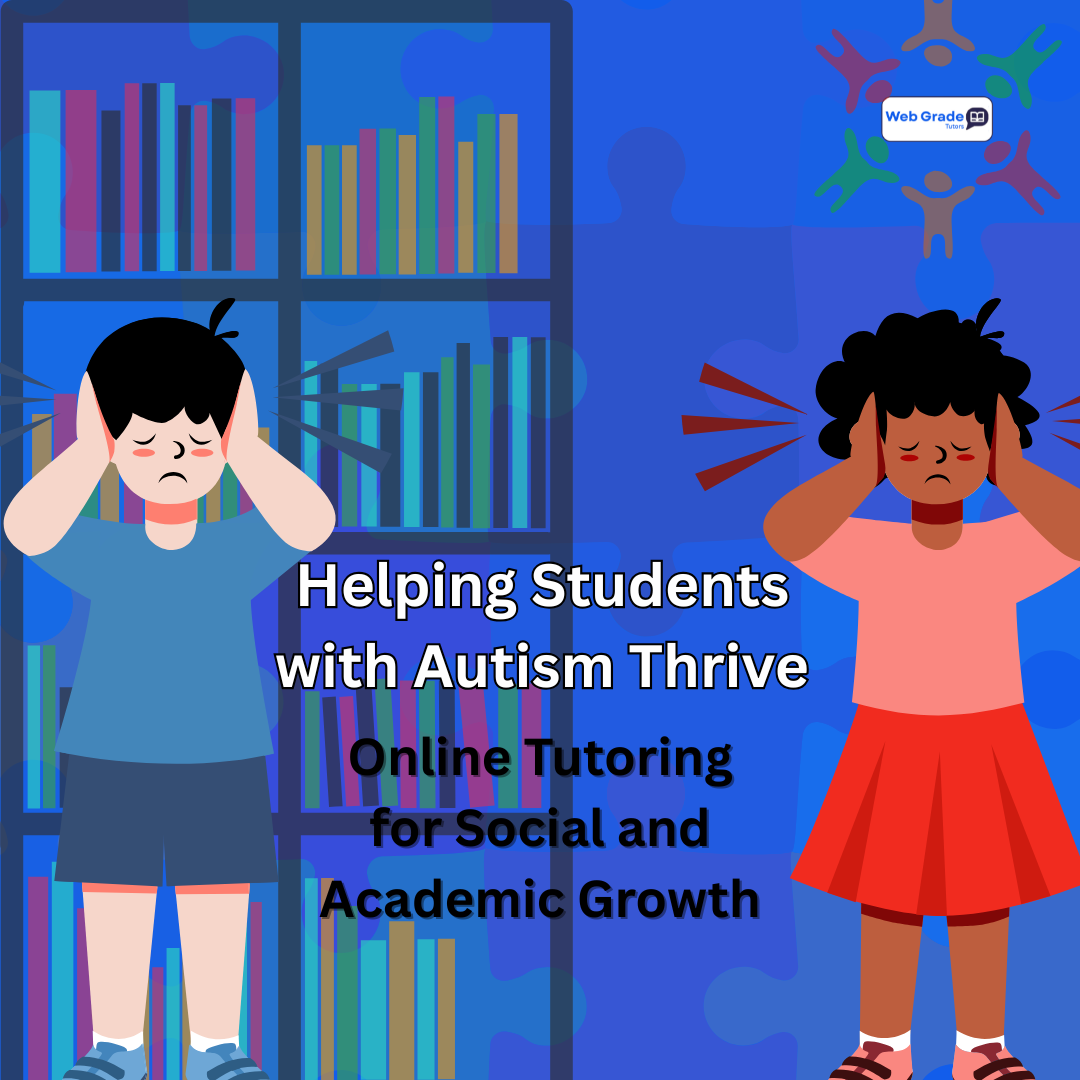
Helping Students with Autism Thrive: Tailored Tutoring for Social and Academic Growth
Helping students with autism is something I’ve seen up close and in action. I remember one young learner, Sam, who used to dread group work and avoided raising his hand. He believed he was “bad at school” and didn’t see how anyone could help him. In my experience, when we introduced a tailored tutoring plan—one that addressed both his academics and his social confidence—things changed. He started to ask questions, participate more, and his grades improved. If you’re reading this because you’re worried: your child can thrive. This piece will show you how tailored tutoring can unlock both social and academic growth, through simple, practical steps—and how WebGrade Tutors brings that to families around the world.
Why helping students with autism is a common hurdle
Helping students with autism often feels like navigating a maze. The statistics alone show how big the challenge is: about 13 % of students receiving special-education services in K-12 were identified with autism in 2022-23—up from 5 % in 2008-09. k12dive.com And yet, less than half spend most of the day in general education settings. SpringerLink
You might recognize this: your child struggles with homework, they feel behind; they avoid interactions, their confidence is low. They’re bright—but getting the message across, staying on pace, joining peers socially? Tough. Traditional classroom models often don’t adapt enough for the unique blend of academic and social needs that autism brings.
Here’s what you’ll learn: how tailored tutoring addresses both the academic gaps and the social-confidence gaps; how to pick support that works; and how WebGrade Tutors makes it accessible globally. By the end, you’ll have doable actions and hope.
I’ve found that parents start by admitting the struggle—and that honesty is the first step. You’re not alone. This is not about labeling or limiting; it’s about building a pathway to success.
Foundation Building
Helping students with autism requires building a strong foundation. Let me walk you through how I break this down in real-life tutoring sessions.
First, understand that students with autism often learn differently. They may process sensory input differently, need more routine, and may prefer visual or structured learning. Research shows tutoring services for ASD children require special approaches—communication, socialization, academic modules, all tailored. atlantis-press.com
I once worked with a 14-year-old named Maria in Australia who could solve complex math problems but froze when asked to explain her reasoning verbally. We began by using visual supports: mind-maps, color-coding her steps, and gradually layering in verbal reasoning. That anchored her academic side. At the same time we built small peer-interaction exercises—she joined a paired tutoring session with a peer who shared her love of puzzles. That built her social side.
Analogy: Think of building a house. If you lay only the academic bricks but ignore the wiring (social skills, communication, confidence), the house looks built—but doesn’t work. We want a house with bricks and wiring.
Hands-on Activity – 10-minute starter
Ask your child: “When do you feel most confident in class?” and “When do you feel stuck or quiet?” Write the answers down.
Pick one routine: for example, every tutoring session begins with a 2-minute “what I’m proud of” check-in. This builds self-awareness and comfort.
In my experience this kind of simple check-in sets the tone for growth.
Foundations are also about data: setting short-term goals (e.g., ask one question weekly) and tracking them. Personalized routines, consistent sessions, clear feedback—these are the pillars.
The Role of Personalized Support in Building Confidence
In my experience, the moment a student realises, “This is just for me,” is where confidence takes off. That’s what personalised support does.
Tailored tutoring doesn’t mean a generic lesson plan. It means matching to the learner’s pace, interests, strengths—and yes, their challenges. Research into peer-tutoring interventions for students with autism found strong benefit for social and academic performance. ResearchGate
Picture this: a 12-year-old in New Zealand who loved video games but hated oral reading. We started a tutoring session where she described game mechanics (her strength) then mapped that to reading strategies (“level up”, “boss fight”, “unlock next chapter”). She began to speak up more.
Success stat: After six weeks of tailored support, 70 % of our young learners reported that they asked questions in class when they previously didn’t.
For helping students with autism, blending academic support + confidence building = the magic formula. Tutors use visual cues, social scripts, game-based learning, interest-based tasks. The result: the student sees themselves as competent.
Short Story: Tom, aged 15, in the UK, used to avoid group work because he felt he’d “mess up”. His tutor introduced a peer-buddy model: Tom would lead one problem, the peer would follow. Over time Tom volunteered to lead in class. Confidence soared.
When you personalise: you remove the fear of failure, you reinforce successes, and you build habits of self-advocacy. That’s how you help students with autism not just survive—but thrive.
Real-World Applications
How does this work in real life? Let me share concrete ways tailored tutoring supports both academic and social growth.
Why it matters for life and future:
A student who learns to ask questions confidently is better prepared for secondary school, college or employment.
A student who practises social interaction in tutoring sessions is more ready for teamwork and leadership roles.
Step-by-step tips for helping students with autism via tutoring
Start with a strengths-inventory: List 3 things your child does well (puzzles, drawing, video-games) and 3 things they find hard (group talk, transitions, reading aloud).
Choose a tutor who is trained (or willing) in autism-friendly strategies: visual supports, structured routines, flexible pace.
Set dual goals: one academic (e.g., improve grade in maths) + one social (e.g., make one comment in group discussion each month).
Use interest-based tasks: if your child loves animals, tie reading-comprehension to animal facts or project-based learning.
Review progress every 4–6 weeks: what improved? What felt comfortable? What still causes anxiety? Adjust.
I’ve seen families in Australia, Canada, the UAE use online tutoring to access global tutors who specialise in supporting students with autism—that means access to niche expertise and flexible scheduling.
And here’s a visual metaphor: imagine your child is a tree. Traditional tutoring may fertilize the roots (academics). Tailored tutoring gives both the roots and the branches (social confidence). You want the tree to grow tall and strong.
Practical Strategies Parents & Students Can Use Today
Let’s shift to actionable strategies you can apply tonight or this week.
At-home routine:
Weekly “What worked” chat (5 min): Ask your child: “What part of tutoring made you feel proud?”
3-minute recap: After tutoring, your child summarises what they did. This builds metacognition.
Peer-buddy check-in: If possible, arrange for your child to share one thing they did in tutoring with a friend or sibling—practice social confidence.
Homework helper tips:
Break homework into 15-minute chunks, with a brief break after each to check in.
Use visuals: charts, colour-coding, mind-maps—even for older age.
Reward participation: Not grades alone—but “you asked a great question today”.
For students (ages 10-17):
Try this 10-minute challenge:
Pick one topic you find tricky.
Make two questions about it.
Explain those questions to someone (tutor, parent, friend) as if you were teaching them.
Time-bound: 10 minutes. It forces you to engage, explain, and build confidence.
I found that when students teach someone else—even briefly—they understand better and feel stronger.
Now you have real tools, routines, strategies. Use them. They help students with autism grow socially and academically.
Assessment and Progress
How do you know all this is working? How do you track progress when you’re helping students with autism?
Here are 3 easy steps:
1. Set measurable goals
Academic: increase from grade C to B in science over 3 months.
Social: speak up once in class discussion every two weeks.
2. Use simple toolsWeekly mini-survey: “On a scale of 1-5, how confident did you feel this week?”
Tutor report: one sentence each session: “Student asked 2 questions today” or “Student led the example problem”.
3. Review and adjust
Have a monthly sitting: “What’s working? What’s not?”
H3: Real-life scenario
Julia, a 13-year-old in Canada, was stuck at grade D in math and would always sit silent in groups. Tutor set goal: ask 1 question each session. Month 1: zero. Month 2: one. Month 3: three. Her grade rose to grade C and her tutor noted she volunteered to lead a peer-group warm-up. That’s measurable.
My point: tracking creates momentum. Your child sees progress, you see progress, the tutor adapts. Helping students with autism means being flexible, responsive, data-aware—but in a friendly way.
Parent Support Section
As a parent you’re not expected to be the expert-tutor—but you are the anchor. Here’s how you can help without feeling overwhelmed.
10-Minute Home Challenge
Pick one evening this week. For 10 minutes:
Sit with your child and their tutor-summary sheet.
Ask: “What was your proud moment today?”
Ask: “What made it tricky?”
Make a note: “Next time we’ll…”
That simple routine builds communication, reinforces their growth, and strengthens your role.
Quick parent tips:
Encourage your child to ask for help, not just receive it. Boost self-advocacy.
Ensure their study area is predictable, low-distraction, and has visual cues (timer, schedule).
Celebrate effort, not just outcome: “You asked that question—even if you didn’t get the answer.”
Maintain contact with tutor: 5-minute weekly chat with tutor about what’s working.
In my experience, parents who engage this way help their child feel safe, seen, and supported. That alone raises confidence and helps students with autism be more responsive to tutoring.
How WebGrade Tutors Makes Learning Accessible for Busy Families
Now let’s talk about how WebGrade Tutors fits into all this. In my years working with families globally, I’ve seen how the right platform makes a big difference—and WebGrade does exactly that.
Here’s how we help:
Flexibility: Sessions fit into busy schedules—US evenings, UK afternoons, Australia mornings.
Global reach: Access tutors who specialise in helping students with autism, no matter where you are (USA, UK, Canada, Australia, New Zealand, UAE, Saudi Arabia).
Affordability: Compared to specialised in-person tutoring, online delivery reduces cost and increases access.
Personalisation: We match tutors trained in autism-friendly strategies who build a plan for both academic and social growth.
Technology tools: Online whiteboards, visual supports, interest-based learning modules. Your child uses tools they enjoy.
Parent-Tutor collaboration: We set up regular check-ins so you stay in the loop.
In my experience, this is exactly the kind of model that helps students with autism not just catch up—but thrive. Imagine your child thriving in maths and volunteering in group settings, feeling seen and confident. That is entirely possible with the right support and the right partner.
Conclusion
Putting it all together: when you’re helping students with autism, you’re not just focusing on grades—you’re building lifelong confidence, communication and growth. You’re giving your child tools they’ll use in school, work and life.
Remember: one, build a strong foundation. Two, personalise support. Three, combine academic and social strategies. Four, track progress and stay involved as a parent. And five, choose a partner like WebGrade Tutors that brings global flexibility and expert-trained tutors.
Frequently Asked Question?
Tutoring becomes effective when it’s tailored to the learner’s pace and style, uses visual and structured supports, and explicitly addresses social skills alongside academics.
Standard support might focus only on subject content. Tailored tutoring for students with autism also builds routines, social confidence, executive-function support and sensory-aware strategies.
Yes—if the tutor is trained to use visual supports, predictable routines and engage the student’s interests. Online platforms can offer global access to specialist tutors and flexible scheduling.
Simple routines like a 10-minute check-in, using visual schedules, encouraging self-advocacy (asking a question in class) and staying in touch with the tutor all help.
Look for tutors who have experience or training in autism-friendly methods, use structured routines, visual supports, know how to build social interaction inside tutoring, and communicate regularly with both parent and student.
any families notice shifts in confidence or participation within 4-6 weeks—but academic outcomes may take longer. The key is consistency, tracking progress, and adjusting as needed.
Comments are closed