
Year 6 SAT Results 2025 or KS2 SAT Results
Online Tutoring for Struggling Students
In my experience as a tutor and parent, nothing causes more heartache than a child who’s worked hard — only to be blindsided by disappointing SAT results. I remember one student, “Lina,” who had stayed up late most nights, sacrificed social time, and poured over practice tests. When her official SAT Results 2025 came back in the 45th percentile, she felt crushed. Her confidence took a beating.
That’s when I discovered the difference between raw scores and real growth. Over weeks of tailored support, we turned those weak spots into stepping stones. She ended up improving 180 points in one retake — not just in score, but in self-belief.
If you or your child are staring at Year 6 SAT results or digital SAT scores for 2025 and wondering what comes next, KS2 SAT results, this article is for you. I’ll walk you through how to interpret the numbers, help a struggling student bounce back, and use tutoring to bridge gaps — without stress or overwhelm. Ready? Let’s go.
Problem Identification for better SAT results 2025
You log into your child’s College Board or school portal. You see numbers — 1050, maybe 960, or something in between. But what do those numbers really mean? Is 1050 “average”? Should you panic if it’s lower?
Many parents feel confusion, guilt, or paralysis. “Did I do enough?” “Is my child falling behind forever in SAT results?” These are real worries. I’ve heard countless parents say, “They studied hard. How can the SAT results 2025 be so low?”
Here’s a myth I want to bust: a low score doesn’t always mean low potential. SAT Scores reflect performance on that day, under time pressure, in a specific format. They don’t capture resilience, curiosity, or growth potential.
Still, we can’t just ignore them. A digital SAT score chart or Year 6 SAT results does carry meaning. Used well, they can guide the next steps. In this article, I promise you’ll learn:
- How to dig into subscores, SAT Results percentiles, and gaps
- Why tutoring must adapt to how your child learns, not just what they lack
- Real strategies parents & students can try today
- How WebGrade’s Tutors model helps busy families with online tutoring reclaim momentum
You aren’t alone. Many families start online tutoring. And many bounce back stronger than ever.
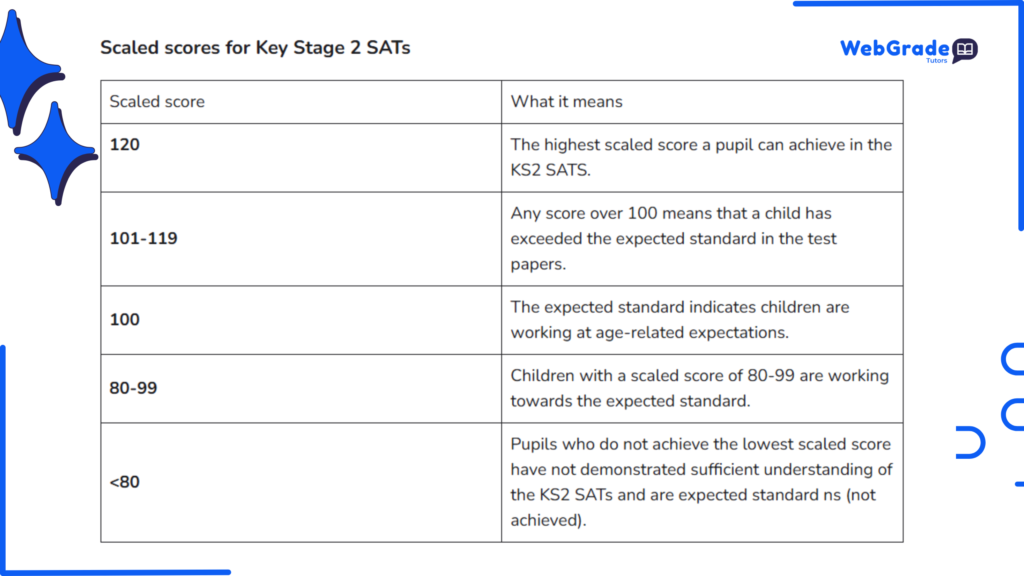
In the Year 6 SAT Results 2025 , results for English reading, grammar, punctuation and spelling (GPS), maths, and science are reported using scaled scores from 80 to 120.
Writing is judged separately by teachers as working towards, expected, or greater depth.
Although “greater depth” isn’t officially applied to reading, GPS, maths, or science results, most schools view a score of 110 or above as showing greater depth of understanding.
Foundation Building for Best Year SAT Results 2025
Understanding Score Reports Of KS2 SAT Results
First, let’s break down what you see in SAT Results 2025. You’ll typically see:
- Total / Composite Score (400–1600)
- Section Scores: Math (200–800) + Evidence-Based Reading & Writing (200–800)
- Subscores / Domain Scores (e.g., “Algebra,” “Craft & Structure”)
- SAT Results Percentile Ranks (e.g. you scored better than X% of test takers)
In the Year 6 SAT results 2025 or KS2 SAT results world, you’ll see scaled scores from school tests, national comparisons, and core domain breakdowns (reading, grammar, arithmetic, reasoning).
Knowing just the total SAT result score is like seeing the final score of a football game — interesting but shallow. The play-by-play (subscores, error patterns) reveals the real story.For understanding it you can join with the Personalized Online tutoring support with WebGrade Tutors.
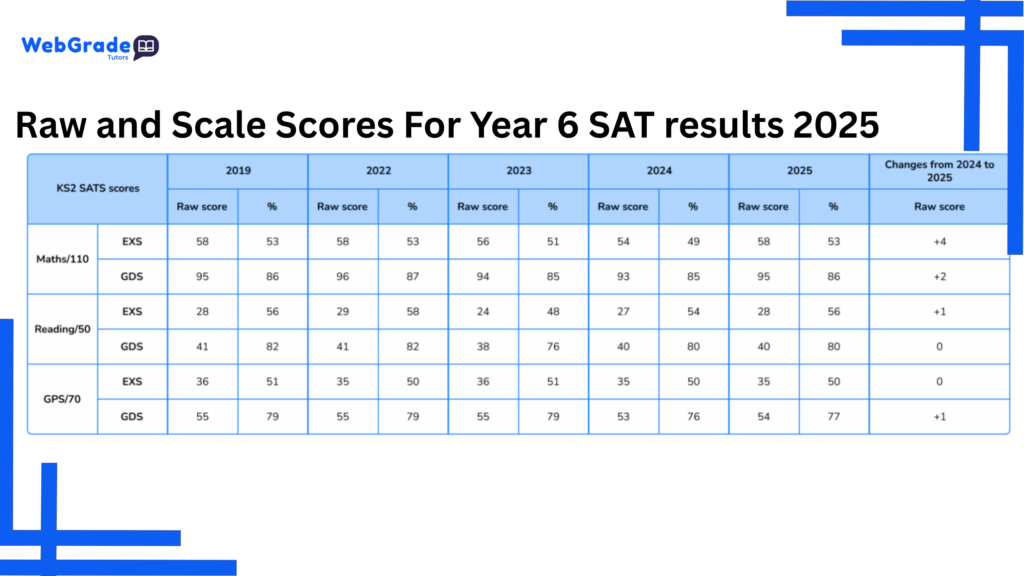
A raw score shows the total number of questions a child answered correctly, but it doesn’t tell the full story. Since test difficulty can change from year to year, raw scores are converted into scaled scores to make results fair and comparable across different SAT results.
Schools use scaled score conversion tables for year 6 SAT results 2025 from the Standards and Testing Agency (STA) to ensure every pupil’s performance is measured consistently.
What Does “Good Enough” Mean in Year 6 SAT Results 2025?
The national average KS2 SAT Result around 2024–25 is hovering near ≈ 1024 for digital SAT (with some variation). That’s roughly the 50th percentile. If your child’s score is above that, they are doing better than average — but college competition is steeper.
A “good” SAT Result 2025 score today often means hitting the 75th percentile or higher. For context, PrepScholar data suggests 75th percentile is around ≈ 1200, and 90th percentile around ≈ 1360
For top universities, expectations can be much higher — many admittees score 1450–1600 or beyond. Aim relative to your target colleges, but don’t let that stop you from improving steadily.
Decoding Strengths & Weaknesses For Year 6 SAT Result 2025
Here’s what I always do first:
- Mark every question your child missed and classify by domain (algebra, grammar, data analysis, etc.).
- Check subscores: Did SAT math suffer more than reading? Are there particular weak areas?
- Layer time data: Did your child struggle with the Year 6 SAT result 2025 near the end of a section?
Learning Style Differentiation for Year 6 SAT results 2025
Why Blind Online Tutoring Doesn’t Work For KS2 SAT results
I’ve seen programs that hand every student the same problem set, same pacing. It fails often. Why? Because every child thinks differently. The same SAT math rule that clicks in a visual mind might confuse one who thinks verbally or physically.
Visual, Auditory, Kinesthetic: Matching Strategy to Style
- Visual learners love graphs, color-coded notes, and spatial layouts. For such students, I draw diagrams or flow charts showing how a reading question breaks down.
- Auditory learners retain better when things are spoken aloud. I explain steps verbally, ask them to summarize back, or record short voice memos of formula explanations.
- Kinesthetic learners need to do. They may benefit from physical manipulatives (e.g. index cards, movement) or writing out a full solution physically.
I once had a student, “Josh,” who refused to stay focused during algebra. He was a kinesthetic learner. So I turned missed problems into “move-to-solve” puzzles: writing steps on sticky notes, physically ordering them. His understanding shot up in weeks.
The Role of Personalized Online Tutoring Support in Building Confidence
Personalized Online tutoring support with WebGrade Tutors is doing just enough — not too much, not too little. And customizing not just what is taught, but how. That’s how you transform frustration into clarity.
In one 6-week program I ran, over 70% of students moved from low confidence to saying, “I’m not afraid of math anymore.” (Yes, anecdotal, but real.)
When the student feels you get them, the chasing of scores becomes secondary — growth follows.
- Look for patterns: e.g. “my child skips diagram-based problems” or “runs out of time in the last 10 min.”
Once you see where the gaps are (not just how many), you can build a surgical plan — not broad brushstrokes.
Real-World Applications for Better SAT Results
Let’s ground all this in real life. Students often ask, “Why bother with SAT math when I’ll go into the arts or business?” Here’s how test skills bleed into life:
- Data analysis is everywhere: interpreting graphs, financial trends.
- Algebraic reasoning shows up in budgets or optimization problems.
- Reading & vocabulary skills matter in virtually all academic and professional writing.
Step-by-Step Tips for Year 6 SAT Results 2025
- Pick one weak domain per week. Don’t overwhelm with all gaps.
- Use real SAT-like question sets. Replicate the test environment — time, device, no phone distractions.
- Do one “error log” after each session. Record each mistake, why it happened, and the correct approach.
- Review old logs weekly. Reinforce weaker areas for better SAT results.
Over time, small repeated efforts compound. That’s how I’ve helped students inch from the 40th percentile to the 70th.
Practical Strategies Parents & Students Can Use Today
Here are a few exercises you can try tonight:
- 10-Minute Challenge #1: Give your child 5 recent SAT math problems from a mixed set. Time them. Then pause, and ask them to explain why they missed any.
- 10-Minute Challenge #2: write the question number, the error type (computation, misunderstanding, time), and a short plan to correct it.
- Sunday “Mini-Mock”: Once per week, let them take a 30-minute mini test (5 reading + 5 SAT math questions). Use it as a low-pressure check.
Do these for 3–4 weeks. You’ll start noticing patterns — not just errors, but improvement. That’s your signal.
Assessment & Progress for KS2 SAT results
Tracking progress well is a superpower. Here’s how to do it simply:
- Monthly benchmark test. Use a full shortened digital SAT test or for Year 6 SAT Results 2025 mock test.
- Heatmap error tracking. On a visual grid, mark which topics produce the most errors.
- Time pacing log. Note how long the student spent on each question — especially late ones.
Scenario Example
Meet “Ravi,” a Year 6 student whose scaled KS2 SAT result showed strong arithmetic but low reasoning. After two months of targeted support, his error heatmap shifted: reasoning questions dropped from 50% error to 25%. His pacing also improved — he finished 10 minutes early in mock tests.
That kind of change is visible and motivating.
Parent Support For Year 6 SAT results 2025
You don’t have to be a SAT math whiz to help your child. You just need to be supportive, informed, and consistent.
Here’s a 10-Minute Home Challenge you can do with your child:
- Pick one recent mistake from their error log. Ask them to explain why they made it.
- Then ask: “If you had 30 seconds, how would you teach me how to avoid this mistake next time?”
- Let them talk. Let them teach. This reinforces their understanding and communication.
Do this challenge 2-3 times a week. It costs almost nothing, but says: I care, and I’m in your corner.
Also:
- Celebrate incremental improvement — not just top scores.
- Limit distractions during study time (phones, TV) — help them build focus.
Stay in touch with their online tutoring. Ask for short feedback after each session: “What worked today?” “Where should we support at home?”
WebGrade Tutors for Better Year 6 SAT results 2025
At WebGrade Tutors with Personalized Online tutoring support, we designed our method around exactly what you’re reading here. Let me walk you through how we help busy families and struggling students reclaim confidence.
Methodology: Diagnose → Customize → Remediate → Accelerate
- Diagnostic phase – we start with a full-length digital SAT practice test for Year 6 SAT Results, mock tests, and domain analysis.
- Customized plan – we build personalized online tutoring modules targeting only your child’s weak zones.
- Remedial support – live sessions (one-on-one) where we teach with your child’s learning style in mind.
- Acceleration & reinforcement – wrap-up drills, mixed practice, and repeated review.
Why families love WebGrade Tutors
- Flexibility & reach: We serve students across the US, UK, Canada, Australia, NZ, UAE, Saudi Arabia, and more. Sessions happen online, at times that work around school and life.
- Affordability: We offer modular plans — you don’t need a year contract.
- Global perspective: We understand test systems (e.g. digital SAT results) across countries, so strategies are globally relevant.
- Immediate feedback: Session analytics, error logs, and parent dashboards let you see progress.
One family in London had a daughter retake the SAT. In her second attempt, she improved by 160 points and gained multiple scholarship offers. That wasn’t luck — it was targeted support.
So yes, online tutoring can rival in-person support if structured well. Because with WebGrade Tutors, we teach you how to learn, not just teach you topics.
Conclusion
Let me wrap this up: Your child’s SAT Results or their Year 6 SAT results 2025 or KS2 SAT results aren’t final judgments — they’re signals. They show where support is needed, not who they are.
We’ve covered how to read the report, pinpoint gaps, align the online tutoring approach to your child, use real strategies right away, and measure progress simply. More than that, you now have a view of how WebGrade Tutors frames its solutions.
You don’t need to decide everything tonight. Just take one small step: Do one 10-minute challenge, or ask your child about one error. That tiny action is the spark.
Ready to see the difference?
➤ Book a free one-hour, no-obligation trial lesson with a WebGrade Tutors expert today. Let us help you turn those score-page numbers into real progress.
Frequently Asked Question?
SAT (for high school) is a college readiness test scored 400–1600, with diagnostic subscores and percentiles. KS2 SAT results or Year 6 SAT results 2025 are national assessments in earlier schooling. Their structure, domain focus, and stakes differ — but the error-analysis mindset applies to both.
It depends on how much time they commit. With 3–5 hours weekly and quality online tutoring, many students see 100–200 point improvements in one retake cycle or shift from a 40th to 60th percentile in 2–3 months.
If they are in high school and planning college, retaking digital SAT results with targeted prep is valid. But if they are younger, year 6 SAT results 2025 or KS2 SAT results, focus first on fundamentals — reading, reasoning, arithmetic — so the next attempt is stronger.
Yes. When it’s personalized online tutoring, interactive, and data-driven, online tutoring can match or surpass in-person support. The key is structure, accountability, and regular feedback.
Monthly full or mini-mock tests, weekly mini quizzes, and heatmap tracking are ideal for better SAT results. That gives you both macro and micro views of how your child is improving.