

Understanding the UK Education System GCSE and more: A Parent's Complete Guide to Key Stages 1 to 4
“I Had No Idea What Key Stage My Child Was In” , A Parent’s Honest Confession
Last Tuesday, I was sitting in a coffee shop with my friend Sarah when she asked me something that stopped me cold: “What Key Stage is your daughter in again?” I stared at her. My mind went completely blank. Reception? Year 2? KS1? KS2? KS3? Honestly, in that moment, I couldn’t remember which was which.
Here’s what I discovered: I’m not alone. In my experience working with hundreds of UK families, I’ve found that most parents feel completely overwhelmed by the UK education system. The terminology, the assessments, the endless acronyms (EYFS, SATs, GCSEs, AQA, Edexcel, Cambridge OCR oh my!). It’s like learning a new language while your child’s education hangs in the balance.
And here’s the thing that keeps me up at night: when you don’t understand the system, you can’t spot the warning signs that your child is struggling. You miss the opportunities to step in early. You feel helpless when your bright, curious child suddenly says, “I’m stupid at maths” or “I hate school.”
If you’ve ever felt lost in the maze of year groups, Key Stages, and assessments, this guide is for you. By the end of this post, you’ll understand exactly where your child is in their educational journey, what to expect at each stage, and most importantly, how to recognize when they need extra support. Ready to take the confusion out of UK education System? Book a free consultation with WebGrade Tutors to discuss your child’s specific needs.
Common Struggles Parents Face When Navigating the UK Education System
Let me tell you about John, a dad I met last year. He moved to Birmingham from Japan when his son was in Year 4. John had a master’s degree, ran a successful business, and spoke perfect English. But when he received his son’s school report, he was completely baffled. “Working at expected standard”, what did that even mean? Was his son doing well? Falling behind? The report was filled with phrases like “greater depth,” “SATs targets,” and “scaled scores.” John felt like he needed a translator for his own child’s education.
Lost in Translation: Year Groups, Key Stages, and Assessment Terminology
Here’s what I’ve found: the UK education system uses terminology that seems designed to confuse parents. In most countries, children are grouped by “grades” (Grade 1, Grade 2, etc.). But in the UK, we have “year groups” that don’t align with ages in an obvious way. A 5-year-old in Reception isn’t in “Year 1.” A 10-year-old might be in Year 5 or Year 6, depending on their birthday. Add in “Key Stage,s” which group multiple years together, and it’s no wonder parents feel lost.
And the assessments? Don’t even get me started. There are Phonics Screening Checks, SATs (which happen twice at different ages), multiplication table checks, mock GCSEs, and actual GCSEs graded on a 9-1 scale that replaced the old A*-G system that some parents still remember.
Missing the Warning Signs That Your Child Is Falling Behind
This is where my heart breaks. I’ve worked with so many families who say, “I wish I’d known sooner.” Their child struggled quietly for months or even years because the parents didn’t understand what “working towards expected standard” actually meant. They didn’t realize that their Year 2 child not passing the Phonics Check was a red flag. They thought mock GCSE results “didn’t count” so they weren’t concerned when their teenager got grade 3s across the board.
In my experience, children are incredibly good at hiding their struggles. They’ll say homework was “fine” when they copied from a friend. They’ll claim they “forgot” their test results. Meanwhile, small gaps become chasms, and confidence erodes day by day.
The Silent Struggle: Children Who Seem “Fine” But Aren’t Thriving
Here’s something I’ve discovered that surprises most parents: the biggest struggles often happen with children who seem “fine.” They’re not failing. They’re not acting out. They come home from school, do their homework, get average marks. But inside, they’re lost. They don’t understand fractions but have learned to fake it. They dread English lessons but smile through it. They’re working twice as hard as their peers for half the results.
These are the children who slip through the cracks because they’re not causing problems. But they’re also not reaching their potential, and that matters just as much.
According to research from the Uk Education System Policy Institute, approximately 30% of UK students finish primary school without reaching the expected standard in reading, writing, and maths. That’s nearly one in three children. Your child’s struggle isn’t isolated; it’s sadly common. But it doesn’t have to be permanent.
Why Understanding the UK Education System Matters More Than You Think
In my years of working with families across England, Wales, Scotland, and Northern Ireland, I’ve found one truth that holds everywhere: parents who understand the system can advocate better for their children. They ask the right questions at parents’ evening. They spot warning signs early. They know when to get extra support and when to simply be patient.
Understanding the UK education system isn’t about becoming an education expert. It’s about knowing to support your child’s journey, make informed decisions, and sleep better at night knowing you’re not missing something important.
Let me break down what you really need to know.
The Five Key Stages: Your Roadmap Through UK Education System
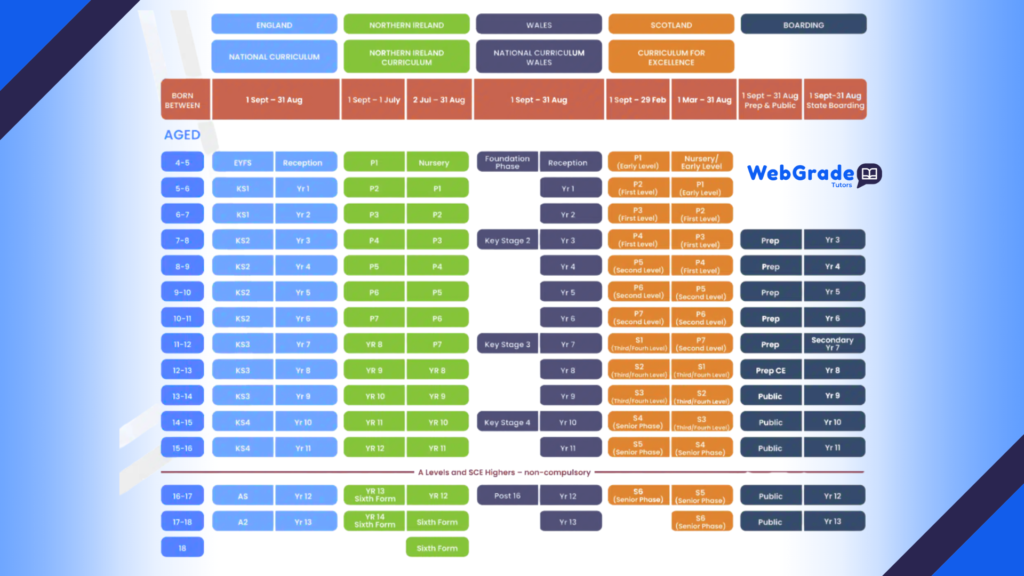
The UK education system is divided into five “Key Stages,” each designed for specific age groups and learning objectives. Think of Key Stages like chapters in a book, each building on the last, each with its own story to tell.
Early Years Foundation Stage (EYFS) – Ages 3-5:
This is where it all begins. Nursery and Reception classes focus on learning through play. Your child isn’t sitting at desks drilling times tables, they’re building with blocks (learning spatial awareness), playing in the sand tray (developing fine motor skills), and singing songs (building language skills).
At the end of Reception, teachers complete an EYFS Profile assessing your child’s development in areas like communication, physical development, and personal, social, and emotional development. Here’s what to watch for: If your child is starting Year 1 and still struggling to recognize their name, hold a pencil properly, or sit and focus for short periods, that’s worth discussing with their teacher.
Key Stage 1 (KS1) – Ages 5-7 (Years 1-2):
This is when formal learning really kicks in. In Year 1, your child takes their first national assessment: the Phonics Screening Check. They’re shown a list of real and nonsense words (yes, made-up words like “pog” or “zat”) to check if they can decode sounds properly.
Here’s what I tell parents: if your child doesn’t pass the Phonics Check in Year 1, it’s not the end of the world. They’ll retake it in Year 2. But it is a sign they need extra phonics support now, not later.
At the end of Year 2, children take their first SATs in reading and maths (though these are optional now and many schools handle them informally). Teachers also assess writing and science. Red flags at this stage include difficulty reading simple books, struggling to write a few sentences, or not being confident with numbers to 20.
Key Stage 2 (KS2) – Ages 7-11 (Years 3-6):
These are the “building years” where children consolidate reading, writing, and maths while exploring science, history, geography, languages, and more. In Year 4, there’s a multiplication tables check (a timed test on times tables up to 12×12).
The big event is Year 6 SATs. These tests in English reading, grammar/punctuation/spelling, and maths are high-stakes because many secondary schools use the results for setting (grouping by ability). A scaled score of 100 is “expected standard.” Scores of 110+ are “greater depth” (high achievement). Scores below 100 indicate your child needs support.
Warning signs in KS2:
Your child takes forever on homework that should be quick. They can’t explain what they’re learning. They avoid reading. They say they’re “bad at maths.” These are all signals to investigate further.
Key Stage 3 (KS3) – Ages 11-14 (Years 7-9):
Welcome to secondary school. The transition from primary to secondary is huge: bigger school, different teachers for each subject, more independence required. KS3 has no national tests, which can be misleading. Parents think, “No exams means no pressure,” but actually, these three years set the foundation for GCSEs.
During Year 9, your child chooses their GCSE subjects. This choice matters. If they drop triple science, they can’t easily take A-Level physics later. If they don’t take a language, some university courses won’t accept them.
Red flags in KS3: Sudden drop in motivation. Friendship drama affecting schoolwork. Not understanding concepts in class but too embarrassed to ask. Increasing homework battles. These are the years where small cracks become big problems if ignored.
Key Stage 4 (KS4) – Ages 14-16 (Years 10-11):
GCSE years. These exams determine whether your child can progress to A-Levels, apprenticeships, or vocational courses. They’re graded 9-1, with 9 being the highest. A grade 4 is a “standard pass,” grade 5 is a “strong pass,” and most sixth forms want grade 6+ in subjects your child wants to continue at A-Level.
In my experience, Year 10 is when families wake up. Mock exams in autumn of Year 11 show results that shock everyone. Suddenly, that “he’s doing fine” becomes “he’s predicted grade 3s.” Panic sets in.
Here’s my advice: don’t wait for Year 11 panic. If your Year 10 child is getting grades 3-4 in subjects they need for sixth form, get help now. Six months of consistent tutoring can transform a grade 3 into a grade 6. I’ve seen it happen dozens of times.

The Role of Personalized GCSE Support in Building Confidence
Let me tell you about Olivia. She came to us in October of Year 11, predicted a grade 4 in GCSE Maths. She needed a grade 6 to do A-Level Psychology, her dream. Her mum said, “She’s given up. She says she’ll never understand maths.”
Here’s what I’ve found: most struggling students don’t lack intelligence. They lack confidence and they lack someone who can explain things in a way that makes sense to them. Olivia’s school teacher was excellent, but with 30 students in the class, she couldn’t give Olivia the individual attention she needed.
We paired Olivia with one of our specialist maths tutors. They met twice a week online, focusing on the topics Olivia found hardest: algebra, graphs, and problem-solving. Her tutor didn’t just teach content, she taught exam technique, showed Olivia how to spot what questions were really asking, and most importantly, rebuilt her confidence one small success at a time.
Over 70% of our students report higher confidence within just six weeks of starting tutoring. For Olivia, the transformation was visible within a month. She stopped saying “I can’t do this” and started saying “Can you show me how?” That mindset shift changed everything.
In May, Olivia sat her GCSE Maths exam. In August, she opened her results with shaking hands. Grade 6. She cried. Her mum cried. Her tutor cried (yes, we cry when our students succeed).
Personalized support works because it addresses the specific gaps your child has, not generic content they may or may not need. It builds confidence through repeated small wins. And it creates a safe space where asking questions isn’t embarrassing, it’s expected.
Regional Variations: Education Isn't the Same Across the UK Education System
Here’s something that catches many families off guard: education in England, Wales, Scotland, and Northern Ireland isn’t identical. Yes, they all have Key Stages (or equivalents), but the details differ significantly.
England: The National Curriculum and 9-1 GCSEs
England follows the National Curriculum, which is mandatory for state schools (though academies have some flexibility). GCSEs are graded 9-1, with emphasis on final exams rather than coursework. Exam boards include AQA, Edexcel, and OCR. Some areas still have grammar schools accessible via the 11+ exam.
Wales: The Curriculum for Wales
Wales is rolling out a new Curriculum for Wales (started 2022, reaching all years by 2026-27). It’s more skills-based and flexible than England’s curriculum. Importantly, Wales still uses the traditional A*-G grading for GCSEs and A-Levels. The main exam board is WJEC.
Scotland: A Completely Different System
Scotland’s system is the most different. They follow the Curriculum for Excellence (CfE) and don’t have GCSEs at all. Instead, students take National 4s and 5s (similar to GCSEs), then Highers (similar to AS-Levels), and sometimes Advanced Highers (similar to A2-Levels). The Scottish Qualifications Authority (SQA) runs all exams.
If you’re moving from England to Scotland or vice versa, curriculum alignment can be tricky. What’s taught in Year 8 in England might be Year 9 content in Scotland.
Northern Ireland: Somewhere in Between
Northern Ireland uses the Northern Ireland Curriculum and has kept the A*-G grading system for GCSEs but added a C* grade to align with England’s grade 5. The main exam board is CCEA. They also have a Transfer Test (similar to the 11+ but different) for grammar school entry.
In my experience, families moving between UK nations need to speak with teachers immediately to identify any curriculum gaps and address them quickly.
Practical Strategies Parents & Students Can Use Today
You don’t need to be an education expert to support your child’s learning. Here’s what I’ve found actually works, broken down by what you can start doing this week.
Strategy 1: Understand Where Your Child Actually Is
Don’t rely on assumptions. Look at their last school report. Google any terms you don’t understand. If it says “working towards expected standard,” that means below where they should be, not “working toward something good.”
10-Minute Action: Tonight, find your child’s most recent school report. Highlight anything you don’t understand. Email the teacher with specific questions: “The report says [X]. Could you explain what this means and whether I should be concerned?”
Strategy 2: Create a Homework Routine That Actually Works
Homework battles are exhausting. In my experience, the key is routine and environment. Same time, same place, minimal distractions. For younger children (KS1-2), 20-30 minutes is enough. For KS3, aim for 45-60 minutes. GCSE students might need 1.5-2 hours, but with breaks.
10-Minute Action: Tonight, set up a homework zone. It doesn’t need to be fancy – just a table, good lighting, and minimal distractions. Let your child choose a “homework playlist” (instrumental music often works best). Try it for a week and see if homework battles decrease.
Strategy 3: The “Three Before Me” Rule
I learned this from a primary teacher, and it’s brilliant. When your child asks for help with homework, they must try three things first: reread the question, check their notes/textbook, ask themselves what they know about similar problems. Only then can they ask you.
This builds independence and problem-solving skills. Most of the time, they’ll figure it out before getting to you.
Strategy 4: Use Free Resources Strategically
BBC Bitesize is fantastic for all Key Stages. Khan Academy is excellent for maths. YouTube has brilliant educational channels. But here’s the key: don’t just tell your child “go watch a video.” Watch it with them (at least the first time). Pause and discuss. Make sure they actually understand, not just consume content passively.
10-Minute Home Challenge:
Pick one topic your child finds tricky. Find a 5-minute BBC Bitesize video on it. Watch together. Pause halfway and ask, “Can you explain what we just learned in your own words?” Then watch the rest. This active watching is far more effective than passive viewing.
Time: 10 minutes, once per week Skill: Active learning and comprehension
How WebGrade Tutors Makes Learning Accessible for Busy Families
I know what you’re thinking: “This all sounds great, but I’m already stretched thin. When am I supposed to find time for tutoring on top of everything else?”
Here’s what I love about how education has evolved: online tutoring has made expert support accessible in ways that were impossible ten years ago. You don’t need to drive across town after work. Your child doesn’t need to sit in a tutoring center until 8 PM on a school night. Quality tutoring now fits into your life instead of taking it over.
24/7 Flexibility That Fits Your Schedule
WebGrade Tutors operates across time zones, serving families in the UK, USA, Canada, Australia, New Zealand, and beyond. Need a Saturday morning session? Done. Sunday afternoon? No problem. Early evening after dinner? We’ve got you covered.
I’ve worked with families where Mum works nights, Dad works days, and the only free time is 4 PM on Wednesdays. We make it work. Because if there’s one thing I’ve learned, it’s that learning shouldn’t be another source of stress. It should fit seamlessly into your life.
Online Sessions: Learning from Your Kitchen Table
Your child logs in from home. No travel time. No rushing. They can be in their comfiest clothes, in their own space, with their favorite water bottle nearby. For anxious students, this is game-changing. They’re more relaxed, more willing to ask questions, more themselves.
And parents? You can be nearby (but not hovering). You can hear how the session goes. You can see your child’s confidence growing in real-time.
Affordability: Quality Support Without Breaking the Bank
Traditional in-person tutoring in the UK can cost £30-60+ per hour. Tutoring centers have overhead costs they pass on to you. Online tutoring eliminates many of those costs, making quality support more affordable for more families.
We offer flexible packages because we know not everyone needs (or can afford) tutoring three times a week. Maybe your child just needs a confidence boost before exams. Maybe they need consistent weekly support. Maybe they need intensive help in one specific topic. We tailor packages to your needs and budget.
Global Reach, Local Expertise
Here’s something special about WebGrade: our tutors understand the UK curriculum inside and out (including England, Wales, Scotland, and Northern Ireland variations), but they also support students globally. That means if you’re a British expat in Dubai, or an international family in London, or a Canadian family whose child follows UK curriculum online, we’ve got you covered.
Our tutors specialize in specific exam boards (AQA, Edexcel, OCR, WJEC, CCEA, SQA) and Key Stages. When you book with us, you’re matched with a tutor who knows exactly what your child needs to succeed in their specific exams, not generic content.
Our Approach: Building Understanding, Not Just Grades
At WebGrade, we don’t just teach content. We teach understanding. Our tutors use active recall, spaced repetition, past paper practice, and exam technique. But more than that, they build relationships. They celebrate wins. They normalize struggle (“Getting stuck is how learning happens!”). They turn “I can’t” into “I can’t yet.”
And the results speak for themselves: 70% of our students report higher confidence within six weeks. Many see grade improvements of 1-2 levels within a term. But the transformation I’m most proud of? The sparkle that comes back into kids’ eyes when learning stops being torture and starts being achievable.
You Don’t Have to Navigate This Alone
Here’s what I want you to remember from this whole guide: understanding the UK education system isn’t about memorizing every assessment and every curriculum detail. It’s about knowing enough to support your child, spot when they need help, and get that help before small struggles become big crises.
You’ve taken the first step by reading this. You’ve learned about Key Stages, assessments, regional variations, and warning signs. Now here’s the next step.
Key Takeaways:
Every Key Stage builds on the last:
Small gaps in Year 2 become big problems by Year 6. Early intervention matters.
“Fine” isn’t always fine:
Children who seem to be coping might actually be struggling silently. Check in regularly.
Understanding the system empowers you:
When you know what “working towards expected” actually means, you can take action.
Support is available:
Whether it’s free resources like BBC Bitesize, school intervention programs, or personalized tutoring, help exists.
You’re not alone:
Thousands of UK parents feel just as confused and overwhelmed as you do. That’s normal. What matters is what you do next.
Ready to Take Action?
If your child is struggling, confused, or losing confidence, waiting won’t make it better. Here’s what I’ve seen time and time again: parents who act early see the biggest transformations. Parents who wait until exam panic sets in face a much harder battle.
Book a free, no-obligation trial lesson with a WebGrade Tutors expert today. In 60 minutes, we’ll assess where your child is, identify specific gaps, and show you exactly how we can help. No pressure. No sales pitch. Just genuine support from people who care about your child’s success as much as you do.
Your child deserves to feel confident in school. You deserve to sleep at night without worrying whether they’re falling behind. Let’s make that happen together.
Frequently Asked Question?
Key Stages are the UK's way of grouping school years together for curriculum planning. They matter because each Key Stage has specific learning goals and assessments. Understanding which Key Stage your child is in helps you know what they should be learning and when to expect major exams like SATs or GCSE. Think of them as chapters in your child's educational story – each builds on the last
Education is compulsory from age 5 to 18 in the UK Education System. Most children start in Reception (age 4-5), though this isn't legally required. What is required is that children are in full-time education from the September after they turn 5. They must stay in education or training until age 18, though this can be school, college, apprenticeship, or work with part-time training.
A "strong pass" is grade 5 in the 9-1 GCSE grading system. It's considered better than the old C grade and is often what sixth forms and colleges require for A-Level entry. A grade 4 is a "standard pass" (roughly equivalent to old C grade), but many institutions now ask for grade 5 or above, especially in English and Maths. For top universities or competitive courses, you'll typically need grades 7-9.
Scotland doesn't use Key Stages or GCSEs. Instead, they follow the Curriculum for Excellence and students take National 4/5 qualifications (similar to GCSEs), then Highers (like AS-Levels), and sometimes Advanced Highers (like A2-Levels). The Scottish Qualifications Authority (SQA) runs exams, not AQA or Edexcel. University entry often happens after Highers in Year 12 (S5), while English students typically need A-Levels after Year 13.
Consider tutoring if your child is consistently working below expected levels, has lost confidence in a subject, is anxious about upcoming exams (especially SATs or GCSEs), has missed school due to illness and needs to catch up, or simply isn't being stretched enough in class. Early intervention works best. Don't wait until exam panic in Year 11 – by then, you're in crisis mode rather than growth mode. If you're unsure, book a free assessment with WebGrade Tutors to discuss your specific situation.
UK schools must provide reasonable adjustments for children with special educational needs. This might include extra time in exams, use of a laptop, coloured overlays for dyslexia, movement breaks for ADHD, or one-to-one support. For more significant needs, you can apply for an Education, Health and Care Plan (EHCP), which legally requires the school to provide specific support. Many children with dyslexia or ADHD also benefit from specialist tutoring that uses multi-sensory techniques and works with their learning style rather than against it.
