
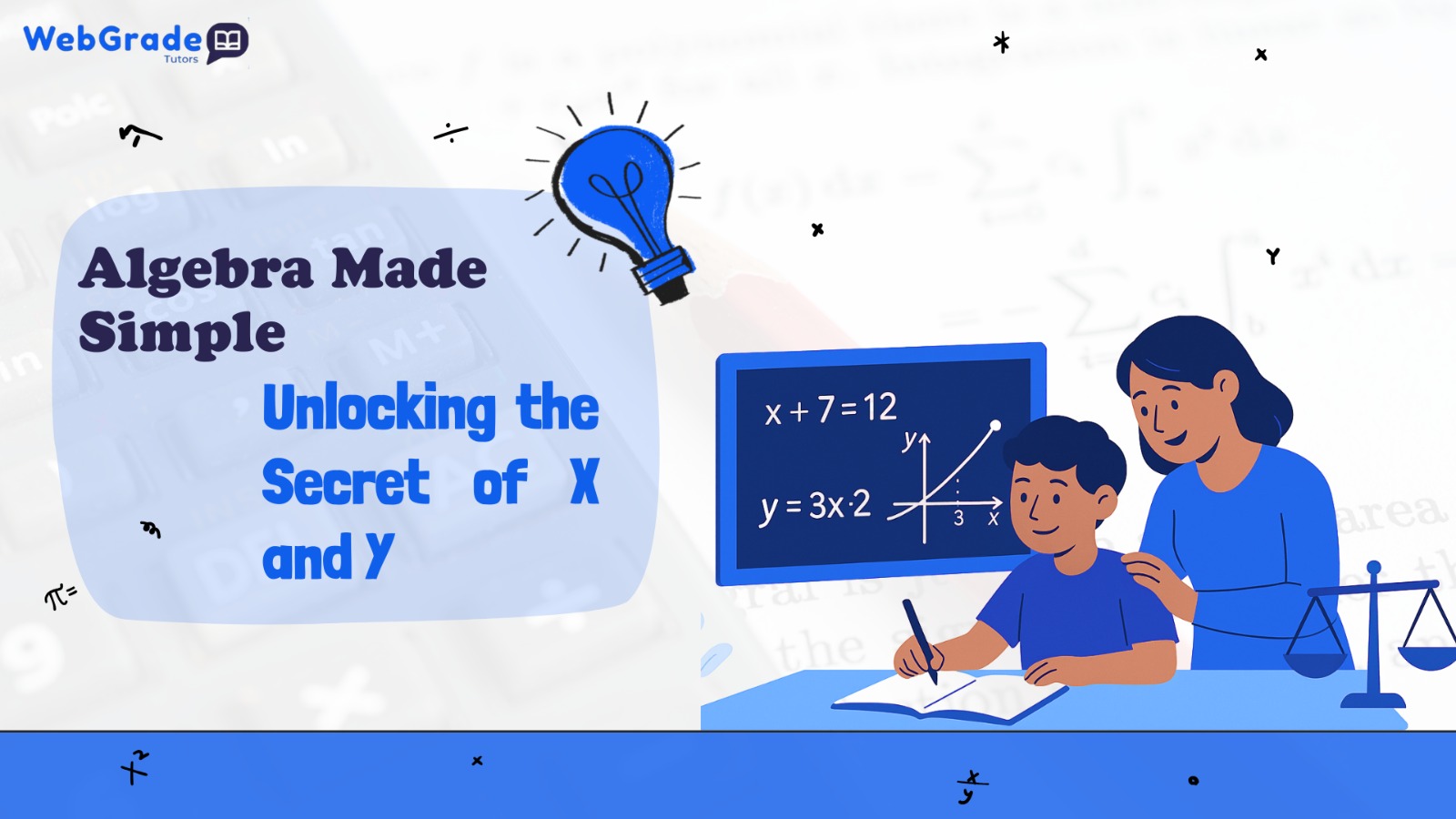
Algebra Made Easy: Unlocking the Secrets of X and Y
Last Tuesday evening, I watched Sarah stare at her homework with the familiar look of defeat. “Mom, why do they put letters in math now?” she asked, her voice trembling with frustration. If this scene sounds familiar, you’re not alone. Every year, thousands of students hit what I call the “algebra wall” – that moment when numbers suddenly mix with letters, and everything feels impossibly complex.
But here’s what I’ve discovered after helping hundreds of families: algebra isn’t the enemy. It’s one of the most practical and powerful tools your child will ever learn. The secret is understanding that algebra is simply arithmetic with a mystery to solve.
Whether you’re a parent watching your child struggle, a student feeling overwhelmed by variables and equations, or a teacher looking for fresh approaches to make algebra accessible, this guide will transform how you think about X and Y forever. You’ll learn how to approach algebra made easy, build confidence in algebra, understand variables and equations, and help your child solve for x and y with clarity.
By the end of this article, you’ll understand why mastering algebra made easy builds confidence that extends far beyond math class—and how the right support can turn your child’s biggest academic challenge into their greatest strength.
Why Students Struggle with Algebra Made Easy
The Real Reason Students Struggle
From working with hundreds of families, I’ve identified the core issue: most students hit algebra before they have a solid foundational number sense. It’s like trying to build a second story when the first floor isn’t finished. They see letters in math and think “variables and equations” must be scary.
For example: 12-year-old Marcus came to me “failing algebra.” We discovered he couldn’t fluently work with fractions or confidently solve multi‐step arithmetic. No wonder his algebra equation felt impossible—he was trying to solve for x and y while still struggling with basic operations.
Reframing Algebra Made Easy: It’s Detective Work, Not Magic
I tell every student: algebra is detective work. You’re given clues (the equation) and your job is to find the missing number (the variable). Once students understand this framework of variables and equations, everything changes.
Consider this simple equation:
x + 7 = 12
Instead of seeing mysterious symbols, students learn to think: “What number plus 7 equals 12?” Suddenly, the abstract becomes concrete, and problem‐solving becomes a logical process rather than guesswork. This is the heart of algebra made easy.
The Confidence Factor
Here’s something many explanations miss: confidence is the biggest predictor of success in algebra. Students who believe they can solve problems approach challenges differently than those who feel defeated before they start.
I’ve watched students go from “I’m not a math person” to “Let me try a different approach” simply by experiencing early success with foundational concepts. That shift in confidence changes everything—and makes algebra made easy truly possible.
Understanding Variables and Equations: The Building Blocks of Algebraic Thinking
What Variables Really Represent
When you hear “solve for x and y,” what does it mean? Variables are placeholder symbols that represent unknown quantities. Think of them as empty boxes waiting to be filled with the right number.
When I explain variables and equations to younger students, I use the “mystery box” approach:
Put 5 toys in a box and close it.
Ask: “If there are X toys in this box, and I add 3 more, how many toys will we have total?”
The equation becomes: X + 3 = (total toys)
When we open the box and count 5 toys, we discover X = 5.
This concrete experience helps students understand that variables and equations aren’t abstract—they represent real quantities we’re trying to figure out. It’s a key step toward algebra made easy.
Real-World Variable Examples That Make Sense
Connecting variables and equations to everyday life dramatically improves understanding:
Shopping Scenario: “If a shirt costs $25 and you have a coupon for $5 off, how much will you pay?” Equation: Final cost = 25 − 5 = $20.
Now add mystery: “If a shirt costs X dollars and your coupon saves $5, what’s the final cost?” Equation: Final cost = X − 5.Time and Distance: “If you walk 3 miles per hour for 2 hours, how far do you travel?” Equation: Distance = 3 × 2 = 6 miles.
With variables: “If you walk at X miles per hour for 2 hours, how far do you travel?” Equation: Distance = X × 2 or Distance = 2X.
These examples make variables and equations concrete, helping students tackle solve for x and y problems with confidence.
Common Variable and Equation Mistakes and How to Avoid Them
Mistake 1: Thinking X always equals the same number. Reality: X can represent any unknown quantity.
Mistake 2: Assuming variables are more complicated than numbers. Reality: Variables follow the same mathematical rules as numbers.
Mistake 3: Trying to guess the variable’s value instead of using a systematic process. The real path to algebra made easy is using structured steps to solve variables and equations.
Mastering Equations: The Heart of Algebraic Problem Solving
The Balance Scale Method That Actually Works
One of the most effective analogies for teaching variables and equations is the physical balance scale. Imagine a perfectly balanced scale with weights on both sides. The equation represents that balance.
Rule 1: Whatever you do to one side, you must do to the other.
Rule 2: Your goal is to isolate the variable on one side.
Example:
x + 7 = 15
Step 1: Identify what’s “attached” to x (the +7)
Step 2: Remove it from both sides (subtract 7)
x + 7 − 7 = 15 − 7 → x = 8
Check: Does 8 + 7 = 15? Yes!
This systematic approach makes solving variables and equations much more intuitive—key to algebra made easy.
Progressive Equation Solving Skills
Level 1: One‐Step Equations
x + 5 = 12 → subtract 5 → x = 7
4x = 28 → divide by 4 → x = 7
x/4 = 6 → multiply both sides by 4 → x = 24
Level 2: Two‐Step Equations
2x + 3 = 11 → subtract 3 → 2x = 8 → divide 2 → x = 4
Level 3: Multi‐Step Equations
3(x + 2) = 21 → distribute → 3x + 6 = 21 → subtract 6 → 3x = 15 → divide 3 → x = 5
These progressive skills help students build the competence and confidence to solve for x and y, making “Algebra Made Easy” a realistic goal.
Practice Exercises for Family Success
5-Minute Daily Drill (Parents & Students):
Beginner Level:
Solve: x + 8 = 15
Solve: 4x = 28
Solve: x − 6 = 10
Intermediate Level:
Solve: 2x + 5 = 17
Solve: 3x − 7 = 14
Solve: x/3 + 4 = 9
Word Problem Challenge:
“Olivia has some stickers. After giving away 5 stickers, she has 12 left. How many did she start with?”
Equation: x − 5 = 12 → x = 17 stickers.
Answer Key:
x = 7, x = 7, x = 16 for beginner drills; x = 6, x = 7, x = 15 for intermediate; Olivia started with 17.
These drills reinforce variables and equations, helping build the foundation for algebra made easy.
Graphical Representations: Making Abstract Concepts Visual
Why Graphs Matter in Algebra Made Easy
Visual learners make up a large part of students, yet traditional algebra instruction often focuses heavily on symbolic manipulation. Graphs help bridge this gap by making relationships visible and concrete. When students can see how changing X affects Y on a graph, algebraic relationships become intuitive rather than mysterious.
Linear Equations: The Foundation of Graphical Thinking
Linear equations create straight lines on graphs, representing constant rates of change—concepts that appear everywhere in real life:
Hourly wages: Total pay = hourly rate × hours worked
Distance traveled: Distance = speed × time
Cell-phone bills: Total cost = monthly fee + (rate × minutes used)
Understanding slope and y-intercept is key: For the equation y = 3x + 2:
Slope (3): For every 1 unit X increases, Y increases by 3
Y-intercept (2): When X = 0, Y = 2
Family Graphing Activity: Plot hours spent studying (X) vs quiz scores (Y). Help your child plot points, draw the line, and look for patterns. Visualizing variables and equations through graphs is a major step toward algebra made easy.
Beyond Linear: Introduction to Quadratic Relationships
While linear equations show steady change, quadratic equations (like y = x²) show accelerating change with U-shaped curves. These appear in projectile motion, profit models, and population growth patterns. Students don’t need full mastery yet, but recognizing that different equation types create different graph shapes builds strong algebraic intuition—another pathway to algebra made easy.
Practical Graphing Exercises
Exercise 1: Phone Plan Comparison
Plan A: $30 + $0.10 per minute
Plan B: $20 + $0.15 per minute
Graph both equations and find where they intersect—showing how variables and equations solve real financial decisions.Exercise 2: Speed and Distance
Graph the relationship between driving speed and trip time using Time = Distance ÷ Speed. Students see how algebra describes everyday experiences.
Building Algebraic Confidence Through Structured Practice
The Psychology of Math Success
Confidence in algebra develops through what I call “progressive mastery”—building success through appropriately challenging problems that gradually increase in complexity. The cycle:
Success with basic problems → confidence
Confidence → willingness to attempt harder problems
Success with harder problems → belief that math makes sense
Students begin to approach new challenges with curiosity rather than fear. Helping students believe in their ability is fundamental to algebra made easy.
Creating Daily Success Habits
Research shows that 15 minutes of focused daily practice creates better results than hour-long sessions twice a week. Here’s how to structure effective practice:
Monday/Wednesday/Friday: Equation solving—start with review problems (boost confidence), introduce one new concept, end with a “challenge problem”.
Tuesday/Thursday: Word problems and applications—focus on translating situations into variables and equations; connect algebra to your child’s interests (sports stats, gaming, money).
Weekends: Graphing and visual activities—create graphs from real data, explore relationships between variables and equations, use online graphing tools or apps.
Overcoming Common Algebraic Roadblocks
“I don’t know where to start.” Teach students to identify knowns and unknowns: What information am I given? What am I trying to find? How are these quantities related? What equation represents this relationship?
“The numbers don’t make sense.” Develop number sense for algebraic thinking: Estimate answers before calculating; check solutions by substituting back; use benchmark numbers.
“Word problems are impossible.” Break down into steps: Read twice, identify the question, list known information, define variables clearly, write the equation, solve step-by-step, and check the answer against the original problem.
These habits transform variables and equations from abstract frustrations into understandable steps—making algebra made easy a reality.
How Online Tutoring Transforms Algebra Learning
Personalized Algebra Mastery
Traditional classroom instruction moves at a fixed pace that often leaves struggling students behind or bores advanced learners. Online tutoring allows individualized attention so that your child can experience algebra made easy on their own terms.
Our Assessment-Driven Approach
Before tutoring begins, we conduct comprehensive assessments to identify:
Foundational skill gaps that impact algebraic thinking (e.g., number sense, fractions)
Current understanding of variables and equations
Learning style preferences (visual, auditory, kinesthetic)
Confidence level and math anxiety factors
Based on assessment results, we create customised learning paths:
Students with weak number sense start with foundational strengthening
Confident arithmetic students accelerate into advanced algebraic concepts
Visual learners receive graph-heavy instruction
Kinesthetic learners work with manipulatives and real-world applications
This approach helps transform variables and equations into understandable elements and makes algebra easily accessible.
Success Stories That Inspire Confidence
Emma’s Transformation: From F’s to A’s in one semester. Challenge: She memorized procedures without understanding concepts and couldn’t solve unfamiliar problems. Approach: Rebuilt foundational understanding with concrete models; connected every algebraic concept to real applications; celebrated small wins; taught systematic problem-solving. Result: By January, Emma earned an A in algebra and chose advanced math next year—and, more importantly, developed confidence that extended to other subjects.
Marcus’s Journey: Overcoming years of math avoidance. Challenge: He believed he “wasn’t a math person” and avoided math entirely. Approach: Integrated algebra applications related to his interest in music production; used beat patterns to teach variables and equations; connected mathematical thinking to logical reasoning he already used. Result: Marcus not only passed algebra but also developed a genuine interest in mathematical problem-solving. He’s now considering engineering programs.
These stories show that when variables and equations are taught correctly and confidence is built, algebra made easy is possible for every student.
Technology That Enhances Learning of Variables & Equations
Interactive Graphing Tools: Students manipulate equations and immediately see how changes affect graphs—making variables and equations concrete.
Adaptive Practice Platforms: AI-powered systems provide problems at exactly the right difficulty level, preventing frustration while ensuring challenge.
Virtual Manipulatives: Digital algebra tiles, balance scales, equation solvers help kinesthetic learners understand abstract concepts through interaction.
Progress Tracking Dashboards: Parents receive detailed reports showing exactly where their child is succeeding and which areas need continued attention.
Practical Strategies for Different Learning Styles
The WebGrade Difference: Personalized Algebra Mastery
Visual Learners: Making Variables & Equations Visible
Visual learners need to see mathematical relationships, not just manipulate symbols. Use color‐coding systems: different colors for variables, constants, operations. Highlight corresponding terms when combining like terms. Create visual patterns that show algebraic structures.
Use graphic organizers: problem-solving flowcharts, concept maps connecting related algebraic ideas, visual templates for different equation types (e.g., one-step, two-step, multi-step).
Examples: graph paper activities showing coordinate relationships, physical algebra tiles for equation manipulation, diagram-based word problems with visual elements. These approaches help make variables and equations tangible—reinforcing algebra made easy.
Auditory Learners: Talking Through Algebra
Auditory learners understand through hearing explanations and engaging in discussion. Encourage students to “talk through” problem-solving steps out loud. Use mathematical discussions to deepen understanding. Provide audio recordings of key concept explanations.
Try algebraic storytelling: “Once upon a time, there was a mystery number X. This number was lonely, so it added 5 to itself, creating X + 5. But X + 5 was exactly equal to 12…” Using narrative to explain variables and equations helps transform “solve for x and y” from intimidating to relatable—enhancing algebra made easy.
Kinesthetic Learners: Moving With Math
Kinesthetic learners need physical interaction to understand abstract concepts of variables and equations. Use hands-on algebra activities: physical balance scales for equation solving, algebra tiles for combining like terms, card sorts for classifying algebraic expressions. Movement‐based learning: walking number lines for positive/negative numbers, physical gestures that represent mathematical operations, and building three-dimensional models of algebraic relationships. These strategies help the tactile learner internalize variables and equations—key to achieving algebra made easy.
Real-World Applications That Make Algebra Relevant
Financial Literacy Through Algebraic Thinking
Algebra equips students to engage meaningfully with personal finance. Simple interest formula: I = P × r × t.
I = interest earned; P = principal; r = interest rate; t = time.
Students can calculate how long savings take to double, compare loan options, determine payment plans. Monthly budget equation: Income = Fixed expenses + Variable expenses + Savings. Students create personal budgets using algebraic thinking—applying variables and equations to real life. When students see how variables and equations apply to their lives, algebra made easy becomes relevant.
Career Connections Across Industries
Healthcare: dosage calculations, medical equipment calibration, and statistical analysis all require algebraic thinking.
Technology: programming languages use algebraic concepts for calculations, data manipulation, and algorithm development.
Business: profit calculations, market analysis, and operational optimisation rely heavily on algebraic problem-solving.
Engineering: design calculations, efficiency optimisation, system modelling require advanced algebraic skills.
These real-world uses of variables and equations show that mastering algebra isn’t just academic—it’s practical. That’s why algebra made easy matters.
Sports and Recreation Applications
Many students connect when they see algebra applied to sports and hobbies.
Sports Statistics: batting averages, shooting percentages, player ratings—variables and equations in action.
Gaming and Technology: video game physics engines use algebraic calculations; 3-D graphics require coordinate system understanding; game balance and probability calculations all use variables and equations.
When students understand how to solve for x and y in contexts they care about, their engagement spikes, and algebra made easy becomes meaningful.
Assessment and Progress Monitoring in Algebra
Diagnostic Assessment: Finding the Starting Point
Before beginning algebra instruction, a comprehensive assessment identifies exactly where each student stands.
Number Sense Evaluation: fraction operations, decimal understanding, integer arithmetic, rational number concepts, proportional reasoning, rate calculations.
Pre-Algebraic Skills: pattern recognition, sequence understanding, basic function concept, and graphical interpretation.
Learning Style Identification: preferred learning modalities, processing speed, attention factors, confidence, and anxiety levels.
This assessment helps tailor the path to “variables and equations” so that your child can experience truly algebra made easy.
Formative Assessment During Learning
Regular check-ins ensure students are building understanding rather than just memorizing procedures.
Daily Exit Tickets: one equation-solving problem, one conceptual question requiring explanation, one application or word problem.
Weekly Concept Checks: mixed practice covering recent topics, error-analysis exercises, and self-reflection on learning progress.
Monthly Comprehensive Reviews: integration of multiple algebraic concepts, real-world problem-solving challenges, goal setting for continued improvement.
Celebrating Progress and Building Momentum
Milestone Recognition: first successfully solved equation, first word problem solved independently, first graph created and interpreted, first real-world application discovered.
Portfolio Development: students maintain math portfolios showing their algebraic journey: before-and-after problem-solving samples, reflection essays on mathematical growth, goal-achievement documentation, and peer-teaching examples.
These practices help monitor progress in variables and equations, ensuring that the journey toward algebra made easy continues steadily.
What If I Can’t Help Because I Don’t Remember Algebra?
This is one of the most common concerns I hear from parents—and it’s completely understandable. Here’s what I tell families: you don’t need to solve the problems for your child—you need to support their learning process.
How Non-Mathematical Parents Can Help:
Ask questions about their thinking: “What does this problem seem to be asking?”
Encourage them to explain solutions in their own words.
Provide a quiet study space and eliminate distractions.
Celebrate effort and persistence—not just correct answers.
If needed, connect with qualified tutoring support focused on variables and equations.
Questions That Support Learning Without Doing the Work:
“What information are you given to work with?”
“What do you think might be a good first step?”
“Does your answer seem reasonable?”
By adopting this supportive role, you help your child build their problem-solving skills and confidence in algebra. You help make algebra made easy accessible even if you don’t remember algebra yourself.
Is Algebra Really Necessary for My Child’s Future?
Absolutely. Beyond STEM careers, algebraic thinking develops problem-solving skills that transfer to every area of life.
Critical Life Skills Developed Through Algebra:
Logical reasoning and systematic thinking
Pattern recognition and relationship analysis
Abstract thinking and generalisation abilities
Persistence when facing complex challenges
Career Flexibility:
Students with strong algebraic foundations have access to higher‐paying career paths and can adapt more easily to changing job markets. When your child masters variables and equations and embraces algebra made easy, they’re building a versatile foundation for lifelong learning.
My Child Has Math Anxiety – Will Algebra Make It Worse?
Math anxiety is real and serious—but algebra instruction can help reduce anxiety when approached properly.
Our Anti-Anxiety Approach:
Start with confidence-building success experiences.
Connect all concepts to familiar, non-threatening contexts.
Emphasize understanding over speed.
Celebrate mathematical reasoning, not just correct answers.
Provide multiple ways to demonstrate understanding of variables and equations.
Students with algebra anxiety often show remarkable improvement in confidence once they experience systematic success with foundational concepts and see that solving for x and y is just logical thinking—not magic. That shift is at the heart of Algebra Made Easy.
Looking Ahead: Building Long-Term Mathematical Success
Preparing for Advanced Mathematics
Strong algebraic foundations prepare students for success in higher-level math courses.
Pre-Calculus Readiness: functions, advanced equation‐solving, trigonometry applications.
Statistics & Data Analysis: variable relationships, correlation, regression equations, predictive modeling.
Calculus Preparation: rate of change concepts (derivatives), area calculations (integrals), and function behavior.
When variables and equations are mastered early, algebra made easy becomes a launchpad to advanced math.
Life Skills Beyond Mathematics
Algebraic problem-solving teaches students to:
Break complex problems into manageable parts
Identify relevant information and ignore distractors
Test potential solutions systematically
Communicate reasoning clearly and logically
These are life skills—not just math skills. Whether your child enters engineering, business, technology, or any professional field, the ability to think algebraically makes a difference. That’s why emphasis on variables and equations, and achieving algebra made easy, matters.
Conclusion: Your Child’s Algebraic Success Story Starts Today
Algebra doesn’t have to be the academic hurdle that stops your child’s mathematical journey. With the right support, systematic instruction, and confidence-building approach, every student can master variables and equations and develop the problem-solving skills that will serve them throughout their lives.
Remember Sarah from the beginning of this article? Six months later, she’s tutoring her younger brother in basic algebra and considering advanced mathematics for next year. That transformation is possible for your child too.
Ready to unlock your child’s algebraic potential? Begin with daily micro-practice, visual and hands-on activities, and consistent support. Make algebra made easy a reality in your home. Because when you teach your child how to solve for x and y with confidence, you open doors—not just in math class, but in life. Book your 60-minute free trial session with WebGrade Tutors today.
Frequently Asked Question?
Not necessarily. The key is strengthening foundational number sense first (fractions, decimals, integer operations) while gradually introducing variables and equations. Many students benefit from simultaneous work on both areas.
Improvement depends on consistency, the number of foundational gaps, and daily practice. With 15 minutes of focused practice most days, visible progress often appears within 4-8 weeks.
Because the focus is personalised, adaptive to your child’s learning style, pace, and confidence level. Online platforms allow customised reinforcement of variables and equations, and progress is tracked in real-time.
Yes. For students who are comfortable with arithmetic and basic algebra, tutoring can accelerate mastery of variables and equations, introduce advanced problem formats, and build readiness for higher-level math (pre-calculus, statistics).
Aim for 10-20 minutes of focused practice each day solving equations, translating word problems into variables and equations, and graphing simple relationships. Consistency is more valuable than long but infrequent sessions.