
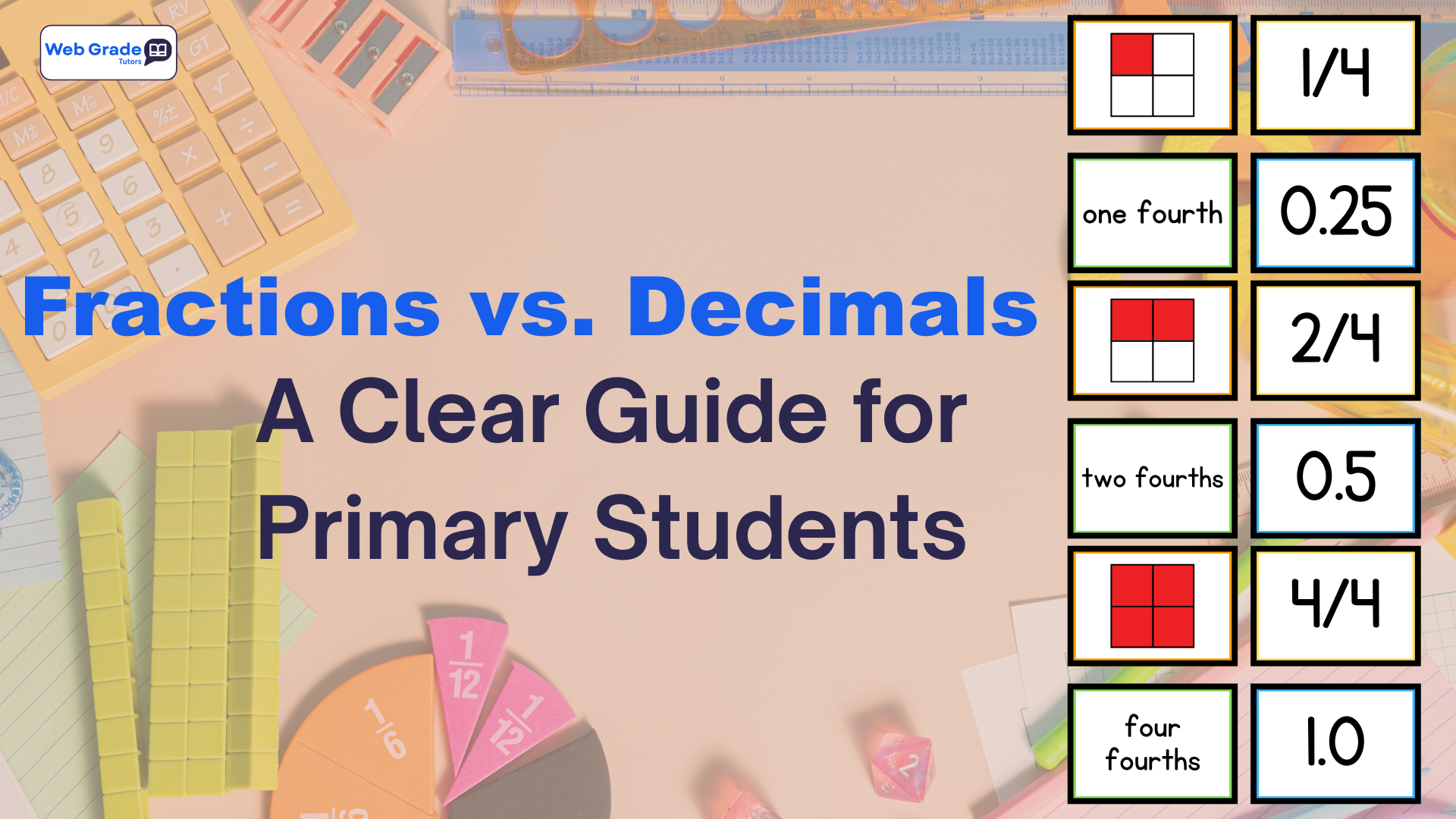
Fractions vs Decimals: A Friendly Parent-Guide for Primary Students
Why This Topic Matters for Parents and Students
If you’ve ever sat at the dining table watching your child stare at a math problem, you’ve probably heard the question:
“Why can’t fractions and decimals just be the same thing?”
For many children, the leap from whole numbers to fractions and decimals feels like stepping into a new language. Parents worry about:
Exam performance is slipping because of confusion.
Loss of confidence in math at an early stage.
How to help when even you haven’t thought about fractions in years.
This guide will break down fractions vs decimals in a clear, friendly way. You’ll see real-life examples, fun explanations, short 10-minute exercises, and how online private tutoring can make these tricky topics feel simple.
Why It Matters for Parents
What is a fraction?
A fraction shows a part of a whole. When we say ¾, we mean three pieces out of four equal pieces.
What is a decimal?
A decimal also shows a part of a whole, but uses tenths, hundredths, thousandths (parts out of 10, 100, 1000). For example 0.75 means 75 out of 100, which is the same as ¾. You’re still talking about the same “part of the whole”.
In fact, math education experts note that decimals and fractions represent the same underlying concept of rational numbers.
Why the confusion?
Because the formats look different, children (and parents!) often feel they’re two entirely separate things. But they’re not. Being able to switch between them builds strong number sense and avoids misunderstandings later on.
Why it matters for you as a parent
Helping your child understand fractions vs decimals in our online private tutoring classes isn’t just about sitting through homework. It’s about building confidence, avoiding early fears of maths, and making sure they don’t stumble when concepts get trickier. Research shows that a weak foundation in these areas is one of the biggest hurdles in higher-level math.
Fractions vs Decimals Explained Simply
The fraction language
Top number (numerator) = how many parts you have.
Bottom number (denominator) = how many equal parts the whole is divided into.
For example, in ⅖: you have 2 parts out of 5 equal parts of the whole.
The decimal language
The decimal point separates whole units from parts of a unit.
Digits after the decimal point represent tenths (0.1), hundredths (0.01), thousandths (0.001) etc.
For example, 0.25 means 25 hundredths, which is the same as ¼.
Converting fractions into decimals
A handy method is: divide the numerator by the denominator.
Example: ¾ → divide 3 ÷ 4 = 0.75 → so ¾ = 0.75 in decimal form.
Why they match
Because both are describing “parts of a whole” — just different ways of writing it. One uses the line (fraction) and one uses place value (decimal).
According to Britannica:
“In everyday mathematics there are two types of fractions, common and decimal … they express the same amounts.”
Real-Life Examples of Fractions vs Decimals for Primary Learners
Every day anchor: pizza or cake
Slice a pizza into four equal slices. If you eat one, you’ve eaten ¼ of the whole pizza.
In decimal form: ¼ = 0.25 (twenty-five hundredths).
Using coins or money: 50 cents is half a dollar → ½ = 0.5 in decimal form.
Grocery modelling
Imagine a toy on sale at 50% off. 50% means half, which is ½ as a fraction, or 0.50 as a decimal.
Using measuring cups: “This cake mix needs ½ a cup” helps visualise ½ = 0.5.
Money connection
When your child sees $3.75 at a shop, you can show that $3.75 = 3 and 75/100 of a dollar, or 3.75 = 3 + 0.75. And 0.75 = ¾.
Using everyday contexts like money and cooking helps children link fractions and decimals in a meaningful way.
Practical Tips for Teaching Fractions vs Decimals at Home
Tip 1: Bring the lesson to wherever you are
At the grocery aisle: “See that toy that’s 50 % off? That’s ½ the price, which equals 0.5 of the original amount.”
In the kitchen: “This cookie mix needs ½ cup – that’s the same as 0.5 of a full cup.”
Tip 2: Use consistent vocabulary
Keep repeating: “fraction”, “decimal”, “part of the whole”. Asking your child: “Is this a fraction or a decimal? How do they link?” helps build fluency.
Tip 3: Daily quick drills
Short, consistent practice beats the occasional long session. Ten minutes a day helps build recognition and conversion skills without fatigue.
Tip 4: Use physical models
Bars, pizza slices, measuring cups, coins – tangible items make the abstract concrete. The research emphasizes that manipulatives help children grasp fractions and decimals better.
Fun Math Activities for Kids to Master Fractions vs Decimals
Activity: Fraction-Decimal Match
Create cards: some show fractions (½, ¾, ⅖, ⅘, ⅛) and some show decimals (0.5, 0.75, 0.4, 0.8, 0.125). Shuffle and have the child pair the fractions with their decimal equivalents. Repeat until they can do it fast.
Activity: Decimal Detective
“Bought 75 cents of candy — how much of a dollar is that as a fraction?”
Answer: 0.75 in decimal → that’s the same as ¾ in fraction form.
Activity: Pizza Night Challenge
Cut a 12-inch pizza into 8 slices. Ask: “If you eat 2 slices, what fraction of the pizza is left? What decimal is that?”
2/8 left = ¼ left = 0.25.
These playful, short activities build both fluency and confidence.
The Role of Private Tutoring in Mastering Fractions vs Decimals
Why one-to-one help matters
When a child repeatedly struggles with “fractions vs decimals”, their confidence takes a hit. A tutor can personalize instruction: identify whether the struggle is with understanding the fraction format, or the decimal place-value format, or the conversion step. Research indicates that a strong foundational understanding of fractions and decimals supports later success in algebra and higher-level mathematics.
Online private tutoring versus in-person
Online private tutoring offers flexibility: evenings, Saturdays, no commute. Many tutoring providers show that children who once stalled at conversion tasks (e.g., ¾ ↔ 0.75) become fluent through targeted, scaffolded practice.
What to look for in a tutoring service
Short, focused sessions on key skills (fractions ↔ decimals)
Real-life contexts (games, money, cooking, shopping)
Regular review and short drills to build speed and confidence
Progress tracking so the child sees improvement (boosts motivation)
How Math Tutoring Builds Confidence and Long-Term Skills
From frustration to mastery
When a child deliberately practices fractions and decimals through guided tutoring, errors become learning opportunities — not sources of shame. They begin to self-correct: “Oh, 0.4 is not ¼ (that would be 0.25) — it’s 2/5 or 0.40.”
Skill that transfers
Fluency in fractions vs decimals isn’t only useful for current homework — it underpins future topics: percentages, ratios, algebraic fractions. A strong base prevents stumbling blocks later. Professional materials emphasize this progression.
Confidence leads to participation
When your child feels comfortable with conversion and representation, they are more likely to raise their hand, attempt new problems, and see math as doable — not as a barrier. That mindset shift is key.
Fraction vs Decimal Review: Quick Practice Ideas
Mini-assessment for home
Write the fraction or decimal equivalent of each: ½ → ___ ; ⅘ → ___ ; 0.125 → ___
Ask: “Which is bigger: 0.6 or ⅘?” (0.6 = ⅗; ⅘ = 0.8 so ⅘ or 0.8 is bigger)
True/False: “0.75 is the same as ¾..” (True)
Convert: 3/10 → ___ ; 0.4 → ___ as fraction.
Self-check prompt for your child
Ask them: “Do I truly understand how this fraction is built? Can I find the decimal by dividing? Can I explain why this decimal equals that fraction?” These reflective questions boost meta-cognitive skill: thinking about their thinking.
Conclusion:
Fractions and decimals can shift from sources of anxiety to instruments of success. With brief, purposeful activities taken regularly, your child’s understanding of fractions vs decimals will grow. The result: better homework performance, stronger number sense, and a confident attitude toward math.
You, as a parent, play a vital part. By making connections in everyday life, modelling conversions, and supporting consistent short practice, you help build the bridge from confusion to mastery.
Interested in personalized online support to accelerate your child’s math progress? There are plenty of flexible tutoring services ready to help.
Ready to help your child master fractions vs decimals with confidence?
Book one FREE online private tutoring trial session with WebGrade Tutors today and see how personalized math tutoring turns confusion into confidence!
FAQs on Fractions vs Decimals for Parents
Because while they look similar (both start with “0.” and a “4”), the fraction ¼ equals 0.25 (not 0.4). That means you have to divide 1 by 4 = 0.25. Confusion often comes from mis-understanding denominators or place value. Parent-guided side-by-side comparisons help.
Use tangible models like pizza slices, chocolate bars, measuring cups. Then show the same quantity in decimal form (e.g., 0.50 cup = ½ cup). The visual + conversion helps cement the idea.
Yes — when the online service uses interactive whiteboards, personalised pacing, and feedback. Many studies and tutor reports show meaningful improvements. The key is consistency, not format.
A sustained period of 10–15 minutes daily, embedded in a consistent routine, can yield significant gains while remaining within a young learner’s attention span.
Start with success in less threatening domains (fractions and decimals), celebrate small wins (correct conversions, quick matching games), and gradually scale. Confidence in early number concepts translates to readiness for algebra later.
Yes. Many online tutoring services offer flexible subscription models, trial sessions, and shorter packages that fit varying budgets. The aim is targeted support rather than long-term fixed contracts.
Comments are closed